©2026 Business Next Media Corp. All Rights Reserved. No.102, Guangfu S. Rd., Da'an Dist., Taipei City 106, Taiwan
Taiwanese Startup Refines GPS Technology to Help Malls, Garages, Factories
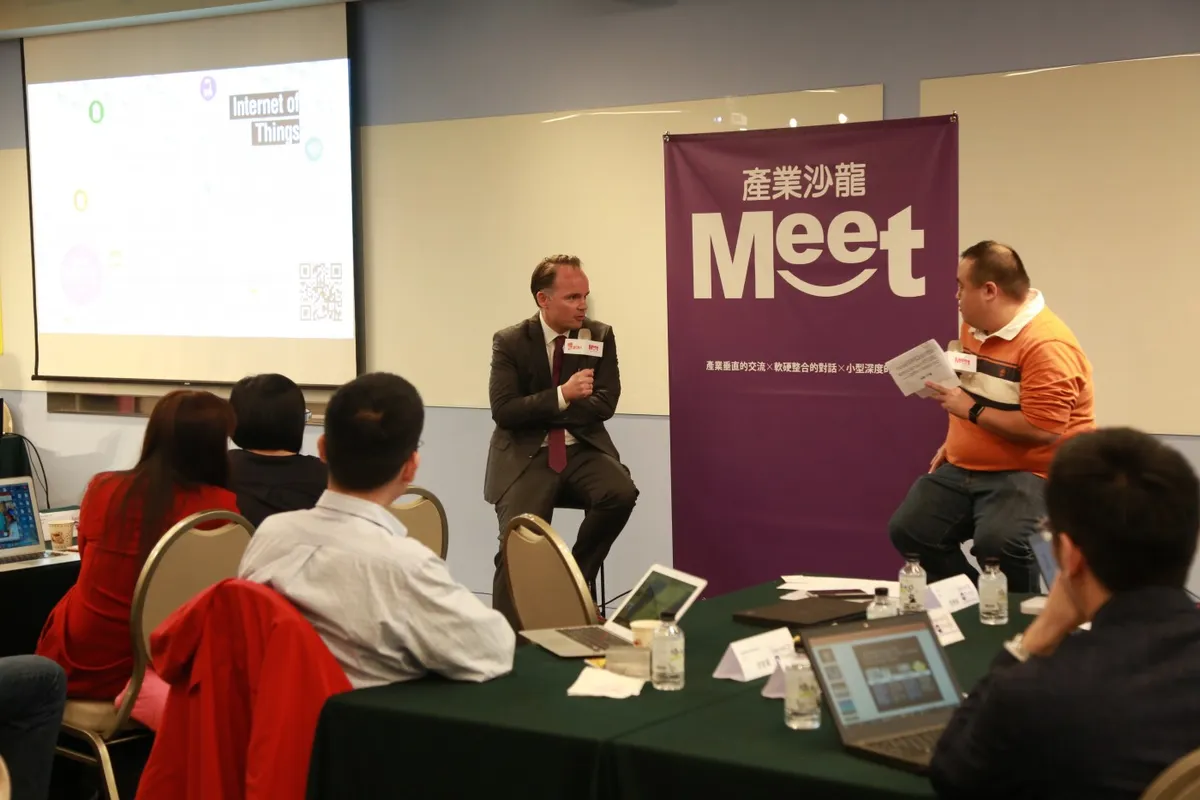
As the internet of things (IoT) is widely seen as a growing subsector of high technology, the Taipei forum Meet IoT Salon invited six top industry speakers to give participants a deeper understanding of IoT and the realm of places where it can be used.
The March 13 event was organized by Meet, is part of the Business Next media group. Meet holds offline and online events to connect startups, venture capital firms and entrepreneurs with the goal of improving Taiwan’s startup ecosystem. Meet’s IoT Salon is one in that series of events.
IoT Pioneers Gather at Meet IoT Salon
Most people have heard of GPS as a system that picks locations by computer and finds them right on the dashboard of a car. A speaker a Meet’s latest event explained how tech firms can take GPS farther.
The 4-year-old Taipei-based firm has mastered the angle-of-arrival method for determining the direction of a radio-frequency waves on an antenna array, or determined from maximum signal strength during antenna rotation. That method is more accurate than other GPS technology, Chen said.
Angle-of-arrival has traditionally been used to discover the location of pirate radio stations or of military radio transmitters.
Indoor positioning works especially in department stores. Starwing counts the Taiwanese mall chain Breeze Center, Taipei Expo Park, the Taiwan Taoyuan International Airport and other big outfits among its customers.
A department store or shopping mall can use the technology to see remotely what spots are most popular at any single time. Large garages and factories can use it to know where things are happening and make follow-up decisions based on activity levels.
Garages and factories can accurately locate movements for discoveries that in turn improve management and reduce accidents.
Starwing has further developed a 3D graphics system for indoor positioning. It finds this system more precise than the more common 2D planar location technology.
The other keynote speaker was Tino Hidebrand, vice president of Siemens Ltd. Taiwan. It belongs to the 171-year-old German firm Siemens, units of which are pursuing IoT-related technology.
To accommodate growth in IoT, Siemens has launched an operating system called “MindSphere”. The cloud-based IoT operating system connects products, plants, systems and machines to let give users analytics that can enhance massive volumes of data.
Hildebrand said data is the important source for companies and a key element for development of IoT. Therefore, he said, firms that use IoT must understand how to digitize large amounts of data for their future development.
©2026 Business Next Media Corp. All Rights Reserved. No.102, Guangfu S. Rd., Da'an Dist., Taipei City 106, Taiwan