©2026 Business Next Media Corp. All Rights Reserved. No.102, Guangfu S. Rd., Da'an Dist., Taipei City 106, Taiwan
Taiwan Forms Alliance to Develop AI Chips
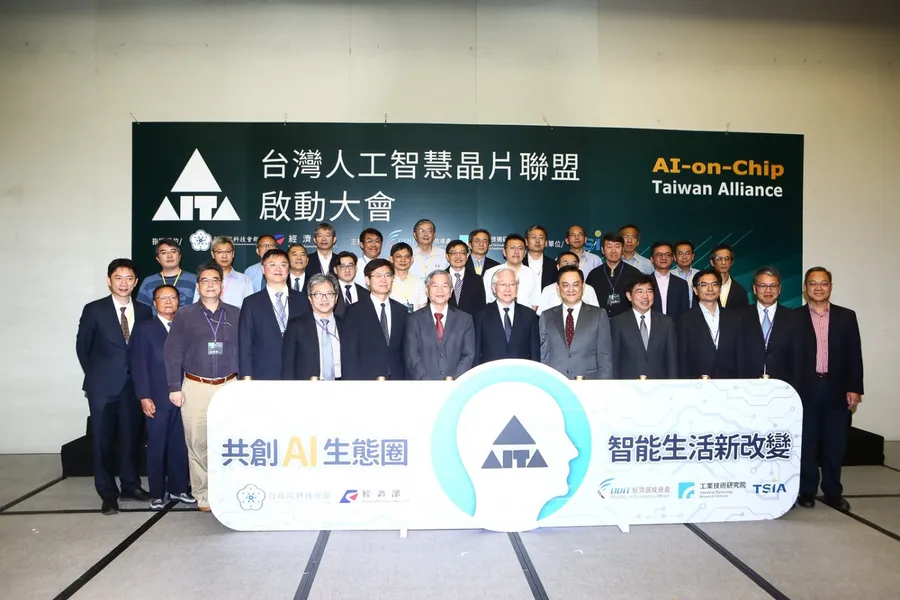
On Jul. 2, Taiwan has formed AI on Chip Taiwan Alliance (AITA) — an ecosystem comprised of more than 50 IT, IC design, software, and semiconductor manufacturing companies aiming to accelerate the development and production of chips for AI.
Led by Etron's CEO Nicky Lu, this group includes Microsoft, Asus, ASE, MediaTek, Quanta, and TSMC.
As AI has gradually become an integral part of modern life, Taiwan, with its advantages in ICT and semiconductor industry, is trying to gain a foothold in the AI chips market.
Taiwan's pain points in AI chips development
The semiconductor industry has been growing for seven consecutive years, Lu said.
The market was valued at $200 billion in 2000 and now has more than doubled, at $480 billion last year.
The development of AI is expected to support and stimulate its growth by helping it expand into agriculture, healthcare, and manufacturing industries.
The value for the AI chips market is estimated to reach NT$500 billion (around $16.1 billion) in three years, according to Shen Jong-Chin, Minister of Economic Affairs.
But there are some difficulties to overcome to get ahead.
The first is the language. Google and Microsoft, for instance, use their own programming language on their AI cloud server.
Taiwan's chips will be restricted to only one type of application if they are designed for one company, Lu added.
Application scenarios are also crucial to AI applications.
In this industry, products are usually designed to meet the requirements for further applications, but in AI, the design of the products can also be contingent upon the requirements.
The last is brain drain. As Wu Tsung-Tsong, Minister without Portfolio of the Executive Yuan, pointed out, some AI professionals in Taiwan have left for China, either headhunted or not.
AITA gathers firms in the industry to battle as a team
This year, AITA is organizing special interest groups (SIGs) to delve into four topics — heterogeneous integration, brain-like calculation, software for AI system, and extended application — fostering vertical integration in the industry.
This way, members in the group can work together to not only spread the risk but develop an standardized interface that can be shared among different companies.
AITA also aims to set up an AI design and verification platform so that its members can develop different products on a large scale and, eventually, expand overseas market.
Speaking of AITA's long-term goal, Chang Shih-Chieh, Deputy Director in Electronic and Optoelectronic System Research Laboratories of Industrial Technology Research Institute of Taiwan (ITRI), said the top priority is to accelerate product development.
Namely, to reduce non-recurring engineering (NRE) by 90% and to shorten the time for R&D by six months.
For Microsoft, they joined the alliance because it guarantees the security of its data on the chips.
Meanwhile, IC design companies pay more attention to the development of AI chips.
Egis pointed out the biggest bottlenecks are power consumption and memory bandwidth.
This is why in AITA, there is a special group that aims to develop inference acceleration cards to decrease power consumption. It is led by Realtek.
Lu said Taiwan is bound to face challenges from Korea and China — the former has invested much in RAM development and the latter supports the emerging industry with national power.
As AI application scenarios are constantly changing, AITA helps centralize resources from its members to ensure a win-win result.
©2026 Business Next Media Corp. All Rights Reserved. No.102, Guangfu S. Rd., Da'an Dist., Taipei City 106, Taiwan