©2026 Business Next Media Corp. All Rights Reserved. No.102, Guangfu S. Rd., Da'an Dist., Taipei City 106, Taiwan
Developing over 3 years, multinational startup Phase is launching a no code digital design tool to save designers
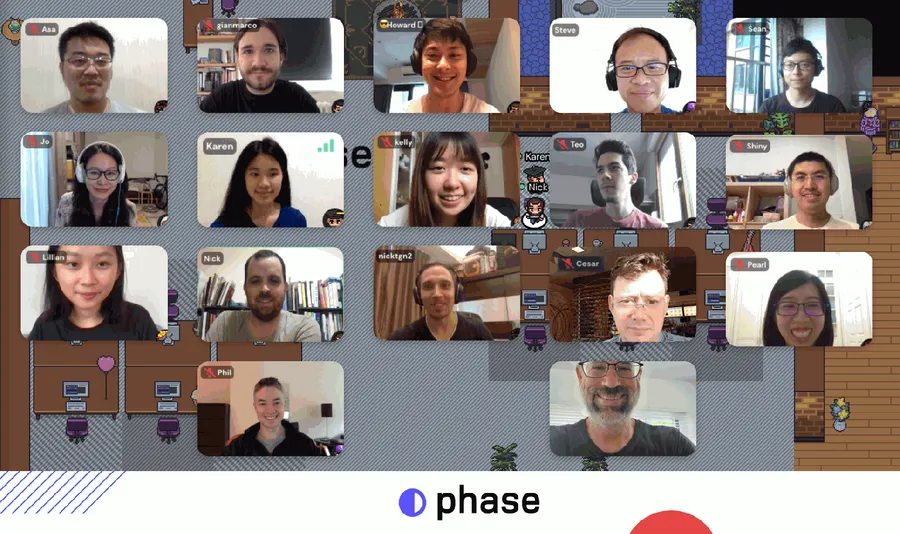
Design expert and serial entrepreneur Nick Budeen spotted the requirement of creating a new digital design tool. He founded Phase and spend over 3 years reinventing a design tool for dynamic design, and the product is expected to launch this year.
Web technology has been growing rapidly since computer scientist Tim Berners Lee invented the World Wide Web. Nowadays, users prefer web products with a user-friendly interface and dynamic design. Creating such web products is complex, it not only needs designers to create a prototype by writing code but also needs designers and front end developers to collaborate closely. However, transferring the design to computer code is hard, and there is always a gap between designers and front end developers.
According to Bret Victor, former Apple designer who worked on the initial design for the iPad, with today’s tool, dynamic design requires creating visuals by writing code, and he thinks it is bizarre that designers can get used to this process.
In the traditional designing process, most of the designs are static and all the digital design tools are built with the Print Design concept, which means they are designed to be printed on paper, as opposed to presented on a digital platform. These tools are not suitable for modern dynamic design that focuses on interaction and motion.
"For decades Print Design Tools have failed to solve digital design problems. Designers are forced to compensate by painfully working directly in code," said Nick Budden, co-founder and CEO of Phase.
Experienced designer Nick Budden wants to reinvent the graphic design tool
Nick Budden, a serial entrepreneur, is a UIUX designer with 10 years of experience. He had established a software startup before called Vectr Labs that aimed at making design simple for everyone. They built an easy-to-use vector graphics editor and grew to over 500 thousand users. The startup was later acquired by Inmagine Group.
During Nick's career as a designer, he faced the same challenge countlessly when collaborating with engineers. With prior experience of running a startup, he wondered, why not start a new venture and reinvent a digital design tool.
Therefore, he founded Phase in 2018, with the focus on building a no-code digital design tool that can accelerate the modern designing process. First of all, to meet the demand for designers who need to collaborate across time zone and across countries, Phase was built to be a web-based digital design editor with a version control feature. Version control can let multi-national teams work together smoothly, and there is barely any other design editor that has this function.
Secondly, Phase enables users to create designs like an animation. "In the traditional tools, when designers want to present what would happen after clicking buttons, they need to draw the same pictures over and over again to represent the motion, but in Phase, one only needs a few clicks to present the interactiveness," said Nick.
Another important feature for Phase would be auto-generating code, and Nick expects to launch this function in the second version of Phase.
“In our first version, we expect a competitive advantage around powerful interactions that are more flexible than other tools. This flexibility allows a designer to create many interactions without code, that they couldn’t do before,” said Nick.
Phase is expected to be launched this year, already attracted users globally
After being developed for over 3 years, Phase is about to be launched in 2021 and soon there will be a second version launched in spring 2022.
"In the short-term, our goal is to get our product to market. Given how complex the product we're building is, this isn't easy. But we're getting very close, and so this is beginning to get quite exciting for us. Once we've gotten the product to market we'll spend the rest of this year iterating on our product to reach improved product-market-fit. So for the near future, our focus is entirely on small iterations on top of our first version," said Nick.
Before the launch of the product, Phase has attracted a beta list of 30,000 designers globally, with 30% in the US and 40% in Europe.
The market size for digital design tools is apparently huge and keeps growing. According to the data, there is a total of 1.8M designers in Europe, 1M designers in the US and Canada, and 3.6 M in Asia.
Phase now has offices in Berlin and Taiwan; they especially set the engineering team in Taiwan due to the high-quality engineering talents. "We've recently raised investment from a number of globally top-tier investors from the US, Europe, and Taiwan. We want to use this money to hire amazing people here in Taiwan. Graphics engineers, QA engineers, and full stack JavaScript engineers. We have set a high bar for who we want to hire, so tracking down the best people we can possibly find is an interesting challenge," said Nick.
So far, Phase has raised over USD$ 4.5 million from VC including Hive venture, 500 Startups, Palm Drive Capital, Paua Ventures, 42Cap, and Anchor Taiwan.
©2026 Business Next Media Corp. All Rights Reserved. No.102, Guangfu S. Rd., Da'an Dist., Taipei City 106, Taiwan