©2026 Business Next Media Corp. All Rights Reserved. No.102, Guangfu S. Rd., Da'an Dist., Taipei City 106, Taiwan
How 17LIVE Global CEO Hirofumi Ono Knew Live Streaming Would Be a Hit
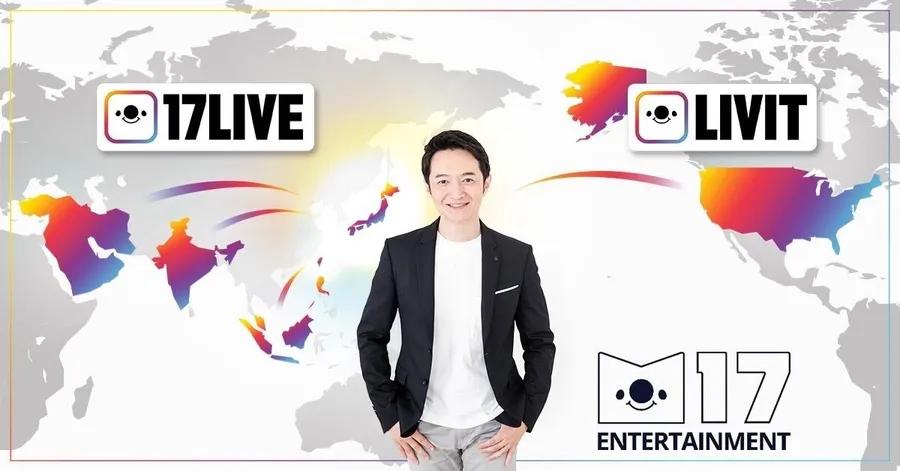
Venture capital firm Headline Asia interviewed Mr. Hiroshi Ono, Global CEO of 17LIVE Inc., the company that provides the live streaming application. 17LIVE is the number one live streaming app in Japan, with more than 45 million users based in six regions worldwide.
Mr. Ono brought live streaming to Japan after seeing the rise in the popularity of live streaming in China. He believes that it’s important to learn from China market while we considering upcoming trends.
Born in 1974 in Sapporo, Japan, Hirofumi Ono graduated from the University of Tokyo's Department of Biological Sciences in 1998 and received his M.S in Biology from the Graduate School of Science in 2000. In 2000, he became the first employee of CA Mobile Inc. and led the company's establishment. In 2008, he established Infinity Ventures LLP. While investing in ventures in Japan and Greater China, Mr. Ono was an investor and serial entrepreneur himself, having led the founding of Sunshine Ranch's Rekoo Japan, Zimoti, Groupon Japan, Farfetch Japan, and others. He also hosted the Infinity Ventures Summit, one of the largest C-level conferences in Japan, for 12 consecutive years.
In 2017, he oversaw the launch of 17 Media Japan (now 17LIVE Inc.), the Japanese subsidiary of M17 Group (now 17LIVE Inc.), which operates the live streaming app 17LIVE. In 2020, he stepped down from his position as President of Infinity Ventures to become the Global CEO of 17LIVE Inc.
What is the state of live streaming in China today?
Users of the top live-streaming platforms in China make up about 10 percent of the population in monthly active users. Considering the population of China, that's over 100 million in MAU. There are several such platforms in existence, such as Kuaishou (519 million MAU, 2021Q1), Douyu (192 million MAU, 2021Q1), and Huya (75.5 million MAU, 2021Q1). The live streaming market is generally considered to be about half the size of the mobile gaming market. This revenue comes mainly from "gifting."
By applying the same calculation to the Japanese market, 10 percent of the population would mean the MAU would fall between 10 and 13 million. As for sales, in general, the mobile game market is about ¥1 trillion, so half of that is ¥500 billion.
In China, the live streaming business is also growing dramatically, and in 2020, about 10 percent of the e-commerce market in China came from live commerce. This number is still small in Japan, but I expect that live streaming will gradually expand the percentage of the e-commerce market in Japan will mirror that of China. Although there is a wide range of services defined as "live streaming," including live commerce, 17LIVE defines the primary live streaming market as "video + communication."
When the context of live performance is added to various contents (games and music) in the entertainment industry, I think a part of them will be gradually transformed into the live distribution market. In other words, there is great potential in terms of the live streaming market’s Total Addressable Market.
What is the value live streaming provides that differentiates itself from other platforms?
Existing live concerts have become difficult to hold due to the pandemic. The movement to replace them with online ones is gaining momentum. Music and live streaming go together very well. For example, a live concert has value in that you can only listen to it when you are there in real-time. There is even more value in having people gather there and the shared excitement. But this can be done without a physical location, reaching more people through live streaming online.
This means that we can express ourselves in new and exciting ways that are possible only in the digital world. We believe that sports game streaming will be further strengthened by translating this series of experiences online and adding "expressions that can only be done digitally." Although we have not yet seen such a significant movement in the sports industry, we expect it will be one of the industries that will emerge with live streaming.
“This means that we can express ourselves in new and exciting ways that are possible only in the digital world.”
In addition, another business model for live streaming is pay-per-view. The number of live music concerts and live sports events going online will definitely increase in the future, and the base will be pay-per-view. On top of that, there will be elements of gifting, and I believe that the three business models, "gifting," "live commerce," and "pay-per-view," will be the focus of attention in the future live streaming market.
In Japan, live streaming is still a new existence. In addition, since the term "live streaming" itself encompasses a wide range of services, I believe that the actual value of live streaming has not been properly conveyed to the world.
I believe that the biggest attraction of 5G — especially millimeter wave 5G (editor’s note: a new frequency band available on 5G) — is that its latency will shrink. Therefore, I expect to see a dramatic evolution in live online communications.
I believe that 2021 will be the first year that the live streaming market will start showing its true value.
The original article How 17LIVE, Inc. Global CEO Hirofumi Ono Knew Live Streaming Would Be a Hit
©2026 Business Next Media Corp. All Rights Reserved. No.102, Guangfu S. Rd., Da'an Dist., Taipei City 106, Taiwan