©2026 Business Next Media Corp. All Rights Reserved. No.102, Guangfu S. Rd., Da'an Dist., Taipei City 106, Taiwan
How Gogoro in Taiwan Built an EV Battery Swap Network
One of the biggest issues with replacing gas powered vehicles with electric ones has to do with recharging. Today, it is simple and easy to fill up your gas powered car. Gas stations are convenient and ubiquitous. You pay, fill up the tank and boom you’re done.
For electric vehicles, things are different. Recharging can take a significant amount of time even at the more advanced charging stations. Having it take 30 minutes is not uncommon.
Recharging should at least partly replicate the gas station experience. But the task of building out an entire network on par with modern gas stations is pretty daunting. But that is something that Taiwan-based Gogoro is trying to do with their battery swap stations.
In this video we are going to look at how Gogoro built out its comprehensive, super convenient 2,000-station strong battery swap network across Taiwan.
Gogoro
Taiwan has the highest density of scooter users in the world. One in every 1.67 people uses a scooter and most of those are gas powered.
Their foul smoke is a big contributor to Taiwan’s haze and air pollution problems. It is not the only polluter of course, but a significant one. An electric alternative would be a definite step in the right direction.
That is what Gogoro is trying to do with their SmartScooter.
Gogoro was founded in 2011 by entrepreneur Horace Luke. Born in Hong Kong and educated in the United States, Luke had been the chief creative officer of handset maker HTC. He resigned to found Gogoro alongside Matt Taylor, HTC's former chief technology officer.
The company launched the Gogoro Smartscooter in 2015 in Taiwan. It was not the first electric scooter to come out in the Taiwan market. Others have tried before but with little success. There are a couple reasons why those electric scooters never caught on before, but recharging is a big one.
Drivers accustomed to gas stations have what is known as "range anxiety", the concern that the EV's range might not be enough to reach its destination. It continues to impede EV consumer adoption today.
So in order for Gogoro to be successful, they needed to tackle the recharging issue right off the bat. Thus, that same year, they began building out what they called Gogoro Energy Network.
The Gogoro Recharging Station
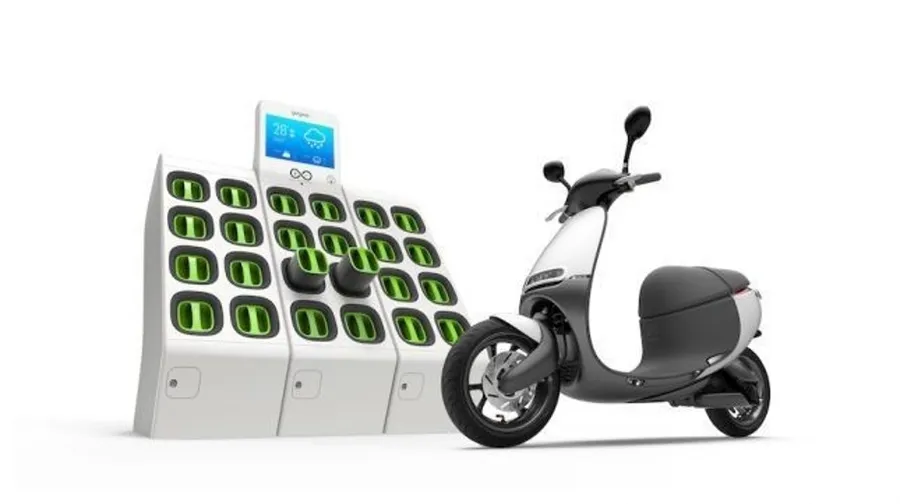
At the heart of the energy network is the GoStation. These battery stations allow customers to swap out a used battery for a new one 24 hours a day, 7 days a week.
Users get access to the stations when they subscribe to a monthly plan. They pay a flat fee and get a certain number of kilometers to drive. If they go over that, they pay per kilometer.
The process is smooth. If your Gogoro starts running low on power, you open up an app and it guides you to the nearest GoStation. The GoStation is not a discrete place like a gas station, but usually is like a kiosk at a 7-11 or some other building.
Once you get to the GoStation, you take the used battery out of your Gogoro (there are two) and plug it into an open slot on the station's wall. The system will run diagnostics and record the battery's receipt. Then a recharged battery pops out elsewhere for insertion into the scooter.
Once the used battery is inserted, the station can either quickly recharge it for future reuse or decide to hold off for until energy prices are cheaper. A user study at a Gogoro battery station finds that the average swap takes about 96 seconds. The most commonly cited issue is that the batteries are a bit heavy (being over 25 pounds or 12 kilograms).
The GoStation has a built-in screen that shows information about the battery, reminders for maintenance and other information like the weather forecast. The internal computer can connect to the greater Gogoro network through cellular or Wifi.
This centralized control allows Gogoro to do several things. First, it can respond to instances of scooter theft. If a Gogoro is reported missing, the company can remotely disable access to its battery network. Eventually the stolen scooter is going to lose power.
Second, the company can look at usage data to determine where to build out additional stations and save on energy grid recharging costs. Considering how many stations there have to be, every little bit helps.
Building Out the Network
Gogoro's battery swap stations have to be convenient to both use and find. That means building them out spot by spot. By the end of 2015, the year of the SmartScooter's launch, there were over 110 GoStations, mostly in Taipei.
Obviously, Taipei is not enough. So the company thereafter built out stations in all of Taiwan's metropolitan areas including Taichung, my hometown of Tainan, and Kaohsiung.
By the end of 2017, stations were added to Yunlin and Chiayi as well - making it possible for a Gogoro owner to ride their electric scooter up and down Taiwan's west side. At that time, the company announced that owners had completed over 4 million battery swaps and counting.
In December 2020, the company gave a presentation to announce that it had built over 2,000 GoStations in Taiwan with over 750,000 batteries currently in service.
The majority of the Taiwanese population is within 1 kilometer of a Gogoro recharging station. Doing all of this took just 5 years. Regardless of what you might say about Taiwan’s density - it’s an achievement.
The Cost of an Energy Network
In a podcast interview, Gogoro engineer Daniel Vickery says that the stations are:
"About as cheap and about as simple to build as one of those Coke machines. This also enables Gogoro to deploy these very fast. We can take an existing city and transform it to be electric, without pulling a bunch of building permits to do any construction or anything like that."
That may be so. But building out a country-wide network will always cost a pretty penny.
I Googled the cost of a coke vending machine, and those sell for about $3-4,000 each. This number is a little lower than what Taiwanese business articles say about how much each GoStation costs.
Their consensus seems to be in the range of $28,000-64,000. And that range makes more sense to me.
Assuming the high end of about $64,000 on average (since there are multiple variants of the GoStation, including a super-sized version), that implies that Gogoro spent upwards of $125 million to build out its battery swap network.
And that does not include the cost of the 750,000 batteries currently in circulation around Taiwan. Each of those cost somewhere north of $700. Nor does it include the cost of renting the land and using the power grid.
That is a heavy cost to swallow for a privately held startup. So let us talk about government subsidies.
Subsidies
Subsidies play a big part in the EV story, for better or worse. Just look at the criticism of Tesla for its reliance on regulatory credits to generate profits. The belief is out there that the EV adoption trend is largely driven by corporate welfare.
In the aforementioned December 2020 presentation, Gogoro says that over half of its GoStations were built out entirely with its own funds. Doing so allows for construction to happen sooner.
The rest of those GoStations have received some form of government support. 657 stations, or a third overall, got a 200,000 NTD or $7,145 USD construction subsidy from the Taiwan government.
And then about 300 GoStations belong to Taiwan's national oil company CPC Corporation.
CPC, looking to improve its environmental impact, committed to rolling out charging stations to some of its 2,400+ petrol stations across the island. This will help availability in rural areas.
So those battery swap stations are fully funded and subsidized by the Taiwanese government through CPC.
The Taiwan government’s subsidy support has effectively deemed Gogoro's battery swap technology the country-wide standard. That has sparked some criticism, but considering the lingering confusion in the US with their various charging solutions, I think it's largely acceptable.
Other than that, the Taiwan Government's approach towards EV scooter adoption has been limited to subsidies. This is rather hands-off in comparison to places like Norway, where EVs owners enjoy no VAT, free city parking and charging, free toll roads, and other such perks.
But I think this approach has benefited Gogoro somewhat. Going by our earlier assumptions, some 80% of the Gogoro Energy Network can still be funded and built without a single dollar of government subsidies. It’s a healthy sign for other companies attempting the battery swap model.
But What About Cars?
When Gogoro debuted its SmartScooter, the EV industry was still trying to decide between charging and battery swapping. Battery technologies continue to advance year after year. As EV ranges increase and recharge times decrease, charging stations become more feasible compared to battery swaps.
Gogoro does offer a mobile charging option for their scooters. And it is important that owners can access that. But the majority of the company's time and investment has gone into their battery swap strategy.
And rightfully so. The Gogoro Energy Network today can largely be considered a success. Widely available, super convenient and affordable. In the coming years, the company says that their focus will be less on the build-out of new stations but rather, expanding the available battery slots at each existing station. So growing capacity to match future scooter sales.
The big question is whether or not the battery swapping strategy can work with cars. Cars use bigger batteries than scooters, and that makes the self-service model much less feasible.
In 2013 Tesla demoed an Autonomous Battery Swap solution in which robots would swap out the drained battery underneath a Tesla S. It was pretty nifty. But a year later, the company ditched that strategy - likely due to consumer disinterest - and worked on building out their Supercharger network.
There remains just one private company trying to make battery swap stations for cars work - China-based Nio with their Nio Power stations.
Their battery swap solution is futuristic and elegant, but as of this writing they have less than 200 stations. The network is far from widespread enough especially in the sprawl of China to fix the range anxiety problem.
Furthermore, the fact that Nio prominently advertises alternate charging solutions like a power charger and a mobile van solution that comes and charges your car is a sign that they know it too.
Conclusion
Having secured strong market share in the Taiwanese electric scooter market, Gogoro is embarking on exporting their technology to overseas markets.
Recently, the company established a joint venture with Hero MotorCorp to enter the India market. Hero-branded scooters using Gogoro battery technology and swap stations would roll out in the world's second biggest two-wheeler market. India's motorcycle market is said to be 18 times the size of Taiwan's.
They have also struck deals with two very large Chinese companies, traditional scooter maker DCJ and electric scooter maker Yadea, to build scooters in China. The scooters would use Gogoro's swappable battery technology and electric drivetrains - the part of the scooter that sends power from the motor to the wheels.
This is a massive opportunity for the company. China has formulated new environmental regulations for scooters and 270 million need to be upgraded by 2025.
There are other obstacles to society adopting electric vehicles en masse that are not discussed in this video. For instance, I have not touched on the unit economics of the scooter itself. But fixing the recharging issues were critical.
Having figured out the situation in little Taiwan, Gogoro is now on the way to making their solution the de facto standard around the world.
©2026 Business Next Media Corp. All Rights Reserved. No.102, Guangfu S. Rd., Da'an Dist., Taipei City 106, Taiwan