©2026 Business Next Media Corp. All Rights Reserved. No.102, Guangfu S. Rd., Da'an Dist., Taipei City 106, Taiwan
AmCham Taiwan to propel young innovators to shine on the global stage: AmCham President
Disrupted supply chain. Soaring demand for chips. Geopolitical tension. Taiwan’s business climate is on the cusp of change. How could Taiwanese startups leap forward with cards stacked against their favor? AmCham Taiwan’s expertise might offer a leg up.
Taiwan is a fierce Asian Tiger, with its sharpest claws being the booming tech and innovation industry. Given Taiwan’s robust economic conditions and political tailwind, Taiwan and the U.S. initiated talks and agreements on multiple issues. Fresh into a new year and taking stock of 2022, Taiwan certainly has made strides resemblant of a majestic tiger.
It’s certainly a fruitful time for bilateral frameworks. The long-frozen Trade and Investment Framework Agreement (TIFA) resumed; meanwhile, Taiwan saw the development of the Technology and Trade Investment Framework (TTIC), engaged in talks with Washington in the Economic Prosperity Partnership Dialogue (EPPD), and recently launched talks on deeper trade connections with 21st Century Initiative.
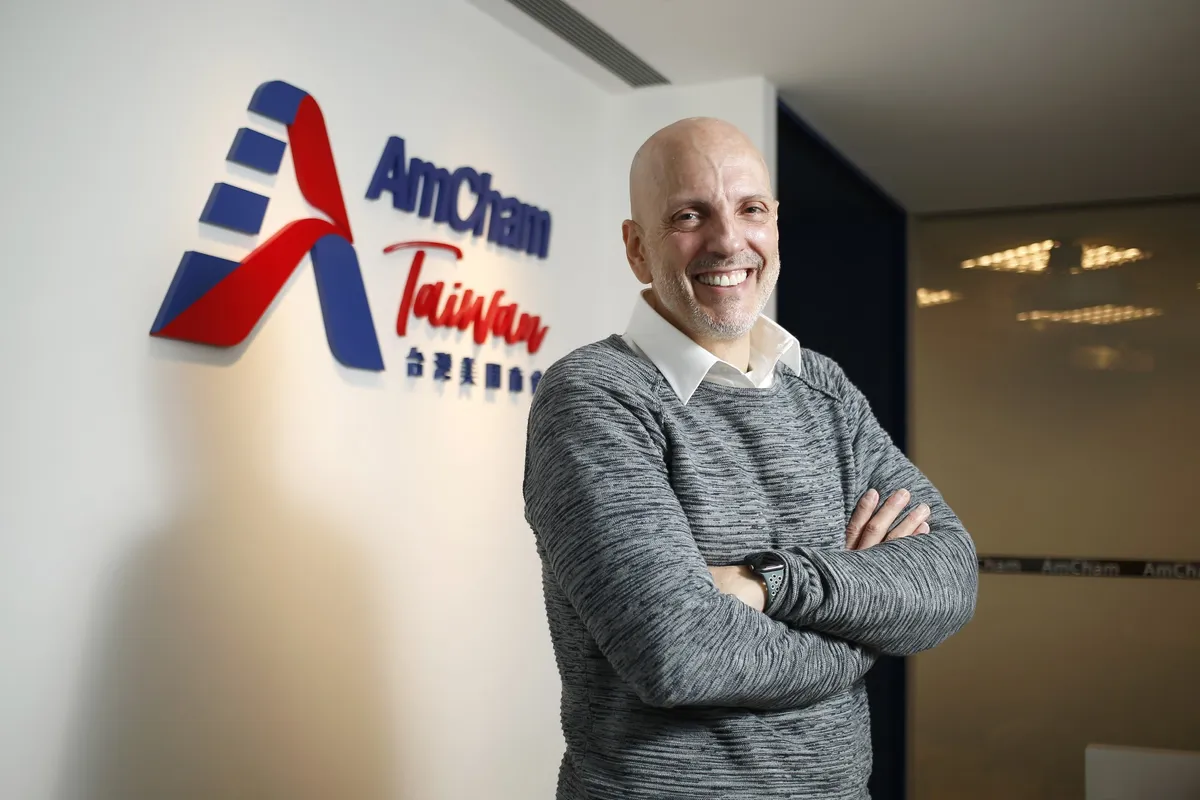
“We’ve gone from zero to four,” noted AmCham President Andrew Wylegala on the recent progress that deserves a round of applause.
In the front-row seat of Taiwan’s trade progresses is AmCham Taiwan, an NGO that hosted committees of multiple industries and advocated key business issues that resulted in the expedition of trade talks between Taiwan and the U.S.
Up until today, AmCham has hosted 560 member companies and 26 committees to promote interests specific to each field. Its’ mission— make Taiwan “more open, innovative, and prosperous for all companies that want to be globally competitive.”
Bring Taiwan to the world, and the world to Taiwan
As a former senior U.S. diplomat, President Wylegala has been stationed in three of the Four Asian Tigers to support commerce in and with East Asia, including Taiwan, Hong Kong, South Korea, and Japan, where he spent the bulk of his professional career.
Born and raised in Buffalo, New York, President Wylegala took interest in international affairs very early on. Seoul, South Korea, was his first foreign posting, where he served as an international trade professional expatriated by the U.S. Department of Commerce. To this day, he has been with the U.S. Department of Commerce for over 23 years.
Jokingly, President Wylegala describes his career path as in “international gypsy” mode in another interview. His expertise brought him to Taiwan in March 2021.
“With AmCham’s support, companies of all sizes figure out who the right partners could be and educate them about the local market. We would also try to introduce American partners or methods to local companies,” said President Wylegala.
To foster a well-rounded business climate, the interaction goes both ways. “We would also take Taiwanese groups back to Silicon Valley so that they could understand the ecosystem there and how U.S. businesses operate.”
“So the main point is to simply understand the differences and to be a good bridge builder,” said President Wylegala, summing up the mission of AmCham Taiwan as the “thread through the needle”.
Be more open to foreign capital
Worries have been expressed by the Taiwanese public that exporting Taiwan’s semiconductor power to the U.S. and other parts of the world would result in fund shortage and a brain drain for Taiwan’s local economy. In response to this popular opinion, President Wylegala offered his first-hand accounts.
“Through our members can say, that's not the full story. That's not happening,” he said.
Micron continues to invest in Taichung while putting high-end EUV capital equipment here. Though not a member of AmCham Taiwan, Nvidia plans to move its hub from Hong Kong to Taiwan. More foreign investments are doubling down in Taiwan.
“It's a well-connected complementary ecosystem. And there's a lot of faith and confidence in the Taiwan part of the puzzle,” concluded President Wylegala.
If Taiwan wishes to bring in more foreign capital, then its regulations need to adopt a more welcoming attitude. With its conservative regulations, banking and investment are far from a smooth process for private investors.
“Foreign capital brings not just money, but the management, the internationalized know-how technology with it,” said President Wylegala. It is all the more reason that Taiwan should be open to foreign investment.
Taiwan will move up the value chain
The founder of TSMC, Morris Chang, recently pointed out that globalization is “almost dead”. Chang was referring to the political and trade divide among superpowers. However, it is far from a doomed remark. Something exciting will emerge from the tectonic shifts of globalization— re-globalization.
“Taiwan is entering extreme re-globalization. In other words, Taiwan businesses are engaging in more diverse markets, moving further away from Taiwan,” said President Wylegala.
“Taiwanese companies are moving up the value chain, not following the old business model of contract manufacturing,” said President Wylegala.
This remark comes amid Taiwan’s semiconductor giants’ recent investment in the U.S. TSMC grabbed global headlines with its recent onshoring of a fab in Arizona. MediaTek is pairing up with Purdue University in Indiana to open a new semiconductor design center, and Foxconn and UMC are also making plans for more solid international cooperation.
AmCham wants to jumpstart Taiwan startups globally
Given scores of aspiring startups aiming to go global, a new committee at AmCham Taiwan is beginning to take shape.
Taiwan is a relatively small market to make a unicorn. Therefore the U.S. market or the global market would be something Taiwanese startups should aim for. However, without prior experience, going global is somewhat of a roadblock for startups.
President Wylegala says AmCham is here to support, “We have business events all year long. As well as leadership enhancement programs that can be sort of a springboard for startups to go overseas.”
“We’re open to serving a younger demographic. The new committee aimed at startups will go by the name ‘Innovation and Entrepreneurship Committee’ or something along that line,” said President Wylegala.
Startups that have joined AmCham Taiwan include e-mobility service provider Gogoro (which announced SPAC in NASDAQ in 2021), travel reservation platform KKday and blockchain-based certificate Turing Certs.
“A new program aligned with young entrepreneurs is in a talk here at AmCham. We will get these firms ready to go overseas. Not only to the US but also Japan or Europe or Southeast Asia,” said President Wylegala.
©2026 Business Next Media Corp. All Rights Reserved. No.102, Guangfu S. Rd., Da'an Dist., Taipei City 106, Taiwan