©2026 Business Next Media Corp. All Rights Reserved. No.102, Guangfu S. Rd., Da'an Dist., Taipei City 106, Taiwan
Undergrad scooter-sharing startup turns around a dead venture project
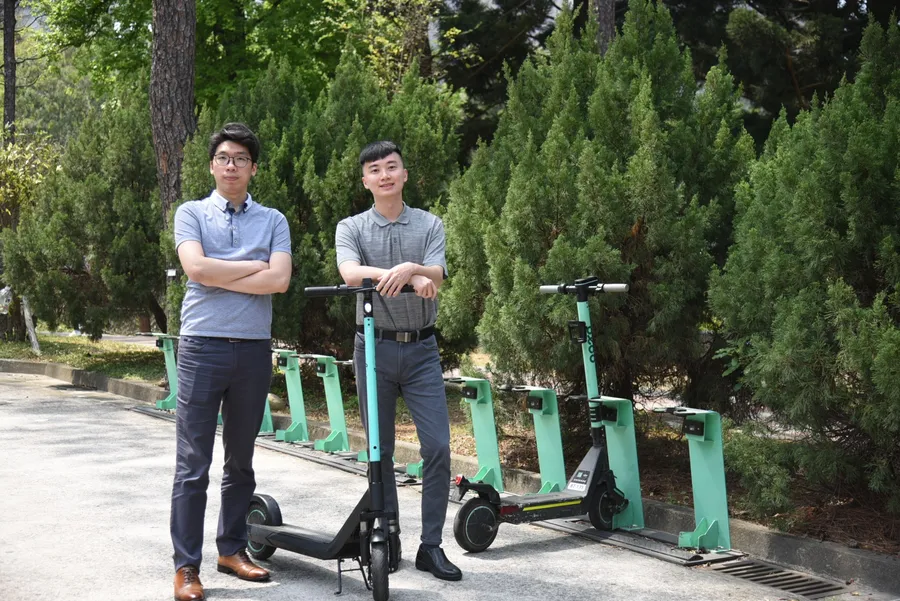
Die-hard scooter startup founders of Looplus pushed through rookie mistakes and deep doubts. Looplus kept things rolling through reinventing themselves and identifying pain points accurately. Bumpy as it is, their startup journey is reaping rewards among the main target audience: college girls and boys.
Zesty-lime-green electric scooters zip across the campuses of Tsinghua University and Chiaotong University. Shared transportation on campus has always been a popular entrepreneurial topic. Many aspiring students invested time and effort in it, only to walk away defeated. This group of students at Tsinghua University thinks this time it might be different.
In 2022, Looplus officially launched oloo, a scooter-sharing platform. Within a year, it had expanded its presence at Tsinghua University, Chiaotong University, Central University, and Tunghai University, raking in 55,000 members and nearly 400,000 uses.
"Surely I'll graduate this year!” co-founder and COO Leo Chang said with a smirk. Chang and Looplus co-founder and CEO Chih-Chia Lin met in 2017. The duo has been working together for six years on their shared transportation venture. At the very beginning, electric scooters on campus were not what they had in mind.
The choppy waters of starting a business
In Hsinchu, ways to get around town are limited. Shared motorcycles were not yet popular. The team conducted a survey and found that 50% of students with motorcycle licenses did not own vehicles.
"Originally, we wanted to work on shared motorcycles. We found that students had trouble commuting to places outside the campus,” Lin recalled. Looplus started the business because the market demand for shared motorcycles seemed obvious.
Lin and Chang collected NT$300,000 from friends, relatives, and their own savings. The duo recruited engineers to join the team through the talent matcher Worca, and started to look for investors. Unfortunately, even though the team developed its own IoT system to control the vehicles, their solution barely caught the eyes of motorcycle manufacturers.
"At that time, China Motors was interested in developing electric scooters. They gave us a shot and commissioned six motorcycles,” they recalled. Unexpectedly, the students only used the service during summer and winter vacations or weekends. A wildly fluctuating usage rate meant that revenue could not cover the cost.
It was the bleakest time for the team. The team spent 4 years in a series of trial and error, with engineers coming and going. “When we are on the brink of giving up, there will be another silver lining prompting us to carry it forward,” said Lin. Looplus pushed through with the thought that there must be a way around their coveted transportation project.
The Aha moment came for Looplus when Chang noticed that the campus is one of the "most frequented starting and ending journey points" in the questionnaire.
"There may be a greater need for on-campus transportation,” as soon as they floated the idea, they knew they’d hit the jackpot. Starting afresh, Looplus pivoted to on-campus transportation.
Looplus believes that electric scooters are more intuitive and user-friendly than bicycles. Scooter riders don’t have to straddle and adjust seat heights. They can also wear dresses without running the risk of exposing. Furthermore, scooter-riders can easily cope with climbing hills as it is electrically powered.
The team spent another year and a half learning the nuts and bolts around a scooter. “It was a hell of a journey,” exclaimed Lin. They learned it the hard way – screw durability, battery power, scooter design, wheel sizes, and shell material – failing at least once before getting everything in the right place.
Turning around a venture previously considered "dead"
It took Looplus nearly six years to finally confirm its direction. In the face of the previous failing experience at home and abroad, such as oBike, Kaohsiung C-Bike, Pingtung P-Bike as well as shared electric scooters providers such as Bird and Lime, Looplus did not back out but rather made adjustments, venturing into the campus scenario.
Speed limit and docked sharing system bode well with universities
In an effort to reduce the risk of accidents and injuries, Looplus has implemented a speed limit of 15 km/h on campus. The decision was made following discussions with schools and aims to promote a safer environment.
Additionally, Looplus has introduced a docked design for their vehicles to improve monitoring capabilities. While this design comes at a higher cost than a non-stationed design, the company believes that it will ultimately save costs through efficient staff management and hardware design. The new design will ensure that vehicles are closely tracked, while problems will be addressed promptly to reduce the risk of breakdowns and accidents.
These initiatives demonstrate Looplus' commitment to safety and innovation in the transportation industry and are expected to have a positive impact on the community.
Finding the leverage: cost-driven and user-driven insight
Cost control and user behavior are the key points in the management of shared electric vehicles, according to Chang. While it may be difficult to differentiate the hardware, Looplus is focusing on efficient cost-control measures and encouraging positive user habits to gain a competitive edge in the market.
Looplus has made significant efforts to improve its maintenance system, implementing a vehicle management software and dispatching system to optimize inspection routes and reduce repetitive work for the staff. The company has also redesigned parts, such as brake fenders, to reduce wear and tear and save costs on consumables.
In terms of dock design, Looplus has recognized the importance of location in maximizing vehicle utilization and turnover rates. The turnover rate of Looplus' shared electric vehicles is currently at 12.3 times per day, while the City Bike of Hsinchu only amounts to 1.3 daily.
Chang, who has a background in traffic and transportation management, has played a crucial role in these efforts. The company is committed to ongoing improvements in both cost control and user behavior to stay ahead in the shared electric vehicle market.
Adding monthly subscriptions and ads
Currently, Looplus' business model is based on the rental fee as the main source of income. The current rate is NT$15 for the first 5 minutes (NT$1 per minute after 5 minutes), and about 300 scooters are placed in 4 schools.
Since the scooters are used more frequently on campus, they are already generating a steady income. This year, we will introduce a monthly fee system and design a new system of membership grading and reservation.
"There is still a lot to try, for example, because of the high turnover rate, we didn't have a reservation system in the past, and all scooters could easily be rented out within 10 minutes at the end of class,” Lin explained.
Looplus is looking forward to the future when the number of scooters has reached a certain amount, advertising will be launched. It will mainly be ads-on-bikes, while the app still maintains a clean and simple user interface, "because this is one of the reasons why users like our service, according to Lin.
©2026 Business Next Media Corp. All Rights Reserved. No.102, Guangfu S. Rd., Da'an Dist., Taipei City 106, Taiwan