©2026 Business Next Media Corp. All Rights Reserved. No.102, Guangfu S. Rd., Da'an Dist., Taipei City 106, Taiwan
Taiwan's Software Industry: Untapped Potential? Silicon Valley Experts Weigh In
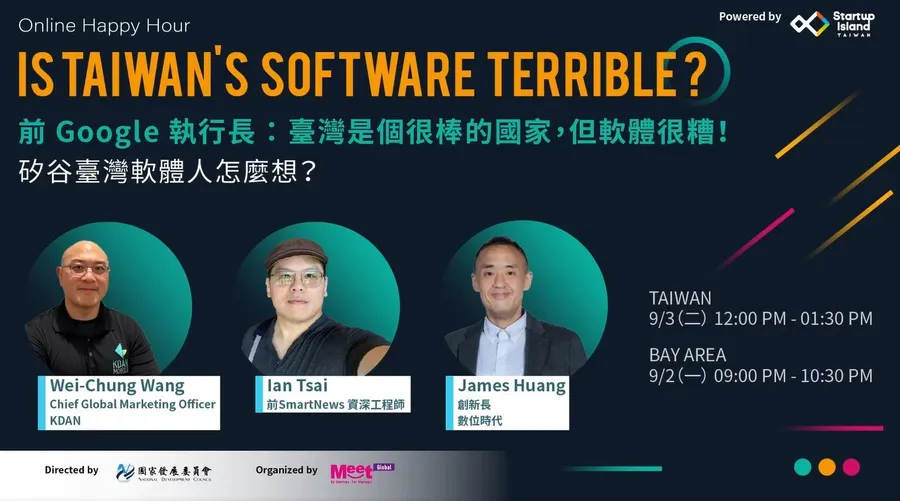
Why is Taiwan’s software industry falling behind while its hardware is leading the world? This was the big question at Meet Global’s Online Happy Hour, where tech experts from Taiwan and the U.S. came together to discuss this pressing issue. Taiwan is famous for its cutting-edge hardware, but its software companies often struggle to make the same impact. The experts agreed: for Taiwan’s software sector to thrive, it needs a fresh approach, one that encourages new ideas, embraces risk, and thinks bigger. To boost its software industry, Taiwan must rethink how it helps its tech talent grow.
Why Taiwan’s Software Needs to Match Its Hardware Strength
Taiwan is known for its strong hardware industry, but its software sector has not kept up. While Taiwan’s hardware products are known worldwide, its software companies struggle to make the same impact. This shows that Taiwan needs to build a stronger software environment, like it has done with hardware.
Experts say that many software companies in Taiwan lack clear job roles and proper structure, which can slow down progress. “In Taiwan, IT and R&D roles often overlap,” said Ian Tsai, a former software engineer at SmartNews. “This mix can hold companies back. In the U.S., clear roles and focused teams help drive new ideas.”
What’s Holding Back Taiwan’s Software Talent?
Wei-Chung Wang, Chief Global Marketing Officer at KDAN Mobile, discussed how Taiwan’s focus on hardware affects its software sector. “Our engineers are very talented, but they often go into hardware because that’s where the money and stability are,” Wei-Chung Wang explained. He stressed that for Taiwan to succeed globally in software, it needs to value software development just as much as hardware.
The experts also talked about the importance of flexible business models. Wei-Chung Wang shared how KDAN Mobile grew from a simple PDF tool to offering subscription and enterprise solutions. “It’s not just about having a great product,” Wei-Chung Wang said. “You need a business model that can change with the market.”
While AI can boost productivity and help with some tasks, it cannot replace human creativity and strategic thinking. “AI helps us work faster, but it can’t make complex decisions for us,” Ian Tsai said. The speakers encouraged Taiwanese engineers to expand their skills beyond coding to include understanding market trends, user needs, and business models.
What Does Taiwan Need to Learn from Silicon Valley?
Wei-Chung Wang and Ian Tsai emphasized that Taiwan needs a stronger ecosystem that supports innovation and risk-taking, much like Silicon Valley and Israel. In these places, there is a culture of embracing failure and learning from mistakes, which helps drive growth. “In Silicon Valley, failure is just part of the learning process,” Wei-Chung Wang said. “We need more of that mindset in Taiwan.”
Creating a supportive software environment means providing funding, mentorship, and resources to help new companies succeed. The speakers stressed the importance of thinking globally and encouraged Taiwanese companies to aim beyond local markets. “We need to compete on the global stage, not just locally,” Ian Tsai noted.
Wei-Chung Wang and Ian Tsai both believe Taiwan’s software industry has the talent to succeed, but it needs the right environment to thrive. “It’s not about what we’re missing; it’s about what we can create,” Wei-Chung Wang said. By valuing software, learning from other successful markets, and using AI as a tool, Taiwan can elevate its software industry to a global level.
Taiwan’s software industry needs to embrace change to keep up with global trends. Taiwan has the talent, but it needs a stronger ecosystem that supports innovation, risk-taking, and a global mindset. By learning from successful models and building a supportive environment, Taiwan’s software sector can rise to the challenge and make a mark on the world stage.
©2026 Business Next Media Corp. All Rights Reserved. No.102, Guangfu S. Rd., Da'an Dist., Taipei City 106, Taiwan