©2026 Business Next Media Corp. All Rights Reserved. No.102, Guangfu S. Rd., Da'an Dist., Taipei City 106, Taiwan
Night Vision, Upgraded: See More Than Just Heat with This New AI Device from Taiwan
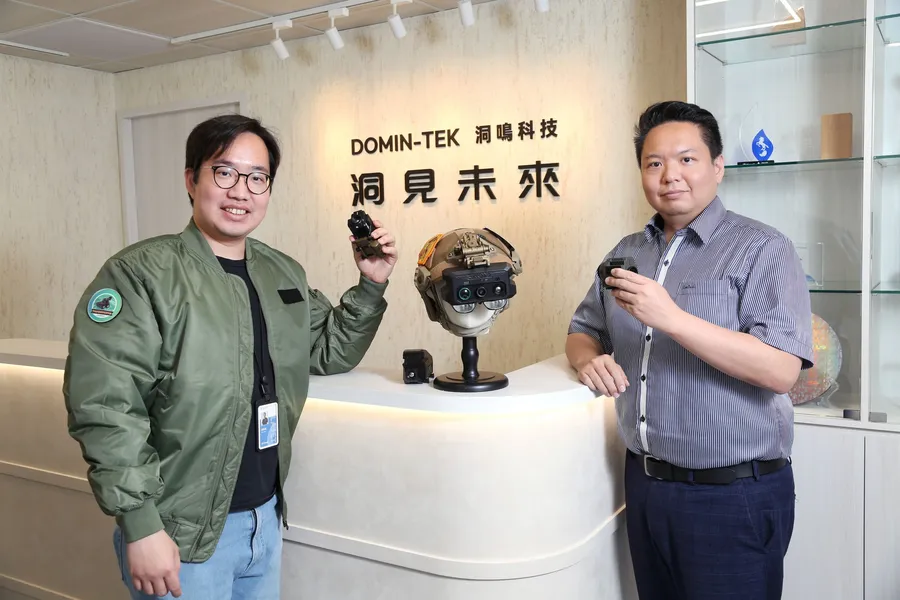
RelaJet, a Taiwanese startup founded in 2018, first gained attention for its AI-driven hearing aid platform, which converts sound into visual data to separate speech from noise.
This approach earned them top honors at the Qualcomm Innovate in Taiwan Challenge, a competition that highlights promising local startups in wireless and AI technologies, as well as recognition from Taiwan’s Ministry of Science and Technology for early-stage innovation.
Now they’re applying the same technical logic to vision.
From Audio Processing to Night Vision Innovation
This pivot wasn’t accidental. CEO Blue Chen is a long-time survival game player who was frustrated by how useless traditional night vision gear became at night. “In a one-hour survival game, you spend 90% of the time just looking for enemies in the dark,” he said. That real-life problem gave the team a direction.
What RelaJet created is a new kind of night vision device. It combines visible light with thermal imaging and processes both using AI. “We call it AI dual-light fusion,” Blue Chen explained. “We extract two sources of light, visible and invisible, and combine them with AI for recognition.”
This allows users to go beyond basic thermal signatures. They can actually see clear outlines of what those objects are. “Traditional night vision just shows darkness. Thermal shows heat but no detail. We combine them, and AI can trace the edge so you see a person’s silhouette or an animal’s outline,” he said.
The system has been tested at 10 meters and is able to show object contours clearly even in near-total darkness. The company’s IVAS product uses three lenses for thermal, night vision, and radar-based range finding. It was built to solve the core problem: identifying meaningful objects when light sources are almost gone.
What Hearing Aids Taught Them About Seeing in the Dark
RelaJet’s transition into vision technology was made possible by their foundation in sound processing. Their hearing aid platform was already turning sound into visual formats like spectrograms for AI analysis. "The algorithmic logic is similar," said COO and Blue Chen's brother Jack Chen. "We trained models to extract meaningful voice signals from noisy environments. Now we extract key visual signals from blurry images."
Because their engineering team was already experienced with chip integration, AI training, and device design, they moved quickly. The team identified the night vision market opportunity in 2023 and dedicated all of 2024 to model training, hardware prototyping, and field testing.
Built in Taiwan, Ready for the World
Instead of developing in isolation, RelaJet focuses on fast POC (proof-of-concept) products, then brings them to potential users for feedback. “We start with a POC and find clients. If they like it, we keep going,” said Jack. This approach lets them tweak hardware quickly and stay flexible.
They also offer multiple engagement models. Clients can buy standard units through distributors, work with RelaJet for customized ODM products, or co-develop full solutions from scratch. Their customers range from outdoor users to industry professionals and government entities.
Being based in Taiwan is also a big advantage. “A lot of night vision gear is still made in China,” said Jack Chen. “Taiwan-made products are more attractive now.” With growing geopolitical concerns, especially in the US and Japan, clients are wary of gear with Chinese chips or manufacturing.
“Night vision devices are often networked. If the system involves Chinese parts, there’s concern about security,” Blue Chen explained. That’s why Taiwanese origin and non-Chinese supply chains have become key selling points. RelaJet has even formed a relationship with Japan’s Elsa Imaging for expansion.
RelaJet’s products first got attention from everyday users. At CES and outdoor shows in Taiwan, they drew interest from hunters, night fishers, and survival game players. “Some players at the outdoor expo just asked the price and wanted to pay on the spot,” Blue Chen said.
Starting with consumer users is part of their plan. It helps them test the product, get feedback, and improve quickly. “The more professional the market, the more trust is required,” Blue Chen added. In Japan, some big companies have even visited their factory to see how things are made.
The team is around 30 to 40 people, with more than half in R&D. Their setup lets them design, test, and revise prototypes in-house, including 3D printing and electronics.
By turning real-world problems into practical solutions, RelaJet has evolved from a hearing tech startup into a company redefining night vision through AI-powered sensory fusion.
©2026 Business Next Media Corp. All Rights Reserved. No.102, Guangfu S. Rd., Da'an Dist., Taipei City 106, Taiwan