©2026 Business Next Media Corp. All Rights Reserved. No.102, Guangfu S. Rd., Da'an Dist., Taipei City 106, Taiwan
RhinoShield Makes Phone Cases. Now They’ve Built a Sea Robot to Clean Up Ocean Trash
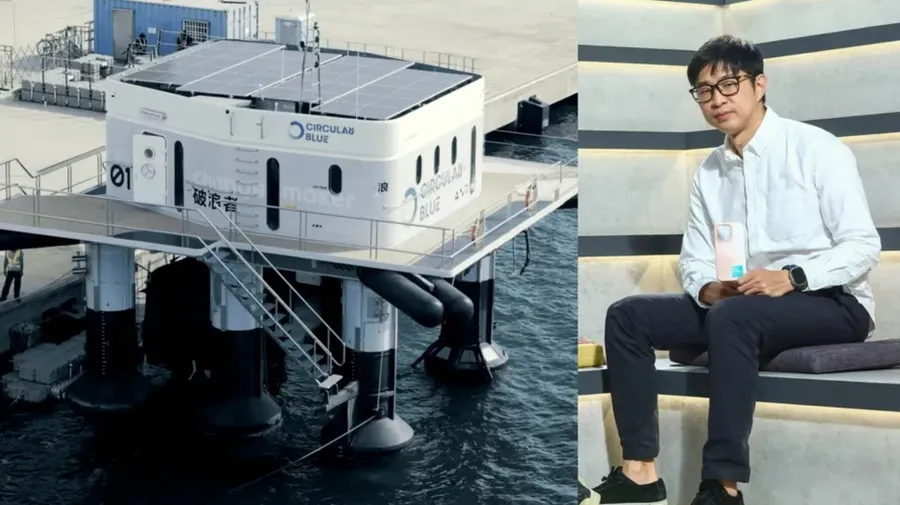
At Xingda Harbor in Kaohsiung, Taiwan, a large, unusual-looking floating structure rests quietly on the sea. It may look like a modern art installation, but it is actually a high-tech ocean cleanup robot.
This project is called ChangeMaker, and it is the first version of a floating marine waste filtering platform developed by RhinoShield, a Taiwanese company known for making tough phone cases. The platform is part of RhinoShield’s new initiative CircularBlue, and it took 18 months and over 2.4 million US dollars to complete.
Like a Roomba, but for the Ocean
The ChangeMaker works like a robot vacuum, but on water. It has a floating base about 12 meters long, 12 meters wide, and 9.4 meters high. It holds unmanned trash-collecting boats and drones.
These drones use AI to find trash in the ocean, then send the boats out to pick it up. After collecting the waste, the boats return to the platform automatically. No humans are needed during this process.
Living Quarters and Eco-Tourism Plans
Inside the platform are four capsule rooms where people can sleep. According to Eric Wang (王靖夫), co-founder of RhinoShield, this space may be used for marine research or educational visits. He even hopes it could one day become a kind of sea-based eco-tourism experience.
“Imagine something like a safari,” Eric Wang said. “But instead of seeing animals on land, you would observe sea life while remaining offshore.”
Why a Phone Case Brand Cares About Ocean Trash
RhinoShield is famous for its drop-resistant phone cases, but it is now turning to ocean cleanup. Eric Wang and his brother Ray Wang (王靖諭), both believe that the brand should be responsible for the plastic waste created by their products.
“We’ve changed our company’s North Star. Our new mission is plastic management,” Eric Wang stated.
The phone case industry produces a lot of plastic. Most phone cases are made of materials that are hard to recycle. And since over a billion phones are sold each year, millions of cases are thrown away. Eric Wang wants RhinoShield to go beyond just reducing waste. He wants to be plastic negative—which means not using any new plastic at all, but instead turning unwanted plastic, including trash from the ocean, into valuable material.
Why Ocean Trash Is So Difficult To Clean
Cleaning up plastic from the ocean is not easy. Ocean trash is often dirty, damaged, or mixed with oil and sea life. That makes it hard to collect, sort, or recycle.
“We’ve done beach cleanups with 500 people working for three hours. We only got two tons of trash,” said Eric Wang.
Recycled ocean plastic also has very little commercial value. Some companies say they use it, but in reality, the amount used can be as small as one gram per product.
The co-founder of RhinoShield saw this gap in the market and decided he should create a solution instead of waiting for one.
From Sketches to a Working Platform
Moving from phone cases to building marine platforms was not easy. Eric Wang visited many shipyards, but most turned him away.
“They said the idea was too strange. No one had ever done something like this,” he recalled.
He kept working after hours and slowly found a shipyard that agreed to join. They did more than just build the parts. They helped with design, modeling, and testing.
Inside RhinoShield, he formed a team of 15 engineers. Since there were no similar machines to copy, the team had to start from zero. They drew hundreds of designs. One was shaped like a whale that would “eat” the trash and spit out water from its gills. While that design did not work out, it inspired new ideas.
The biggest technical challenge was keeping the platform floating at sea all year. They wanted it to stay out during typhoons, because bringing it back to land each time would cost around USD 6,800. That includes dock space, cranes, and equipment fees.
To solve this, the team studied offshore oil rigs. They built the ChangeMaker to use long tubes that go into the sea. These tubes create strong buoyancy and keep the platform above the waves, so even in rough weather, it remains stable. Solar panels provide all the electricity needed for the boats, drones, and any crew on board.
What Comes Next
The ChangeMaker is now docked in Kaohsiung. Soon it will move 1.5 to 3 kilometers off the coast of Tainan’s Golden Coast for testing. While its initial mission is to remove ocean waste, Eric Wang is transparent about the financial challenges.
“Collecting trash alone is not sustainable,” he said. “It costs about USD 5 to recover each kilogram, but we can only sell it for around USD 1.”
That is why he wants to explore other uses. People might pay to stay overnight or use the platform as a base for diving or sea education. This would make the platform self-sufficient without needing government support.
“We’re not becoming a travel agency,” Eric Wang explained. “But if we want to build 10 or 100 of these platforms, we have to make them able to survive financially.”
Building something like the ChangeMaker is not easy. It involves planning, engineering, and risk. For Eric and Ray Wang, it is also a matter of responsibility. They see it as a way for their company to take part in addressing an issue that is often overlooked.
The ChangeMaker is only one platform at this stage. It reflects an effort to find practical ways to deal with ocean waste using available tools, one step at a time.
©2026 Business Next Media Corp. All Rights Reserved. No.102, Guangfu S. Rd., Da'an Dist., Taipei City 106, Taiwan