©2026 Business Next Media Corp. All Rights Reserved. No.102, Guangfu S. Rd., Da'an Dist., Taipei City 106, Taiwan
US to Hit Imported Chips with 100% Tariff Unless Companies Invest in America
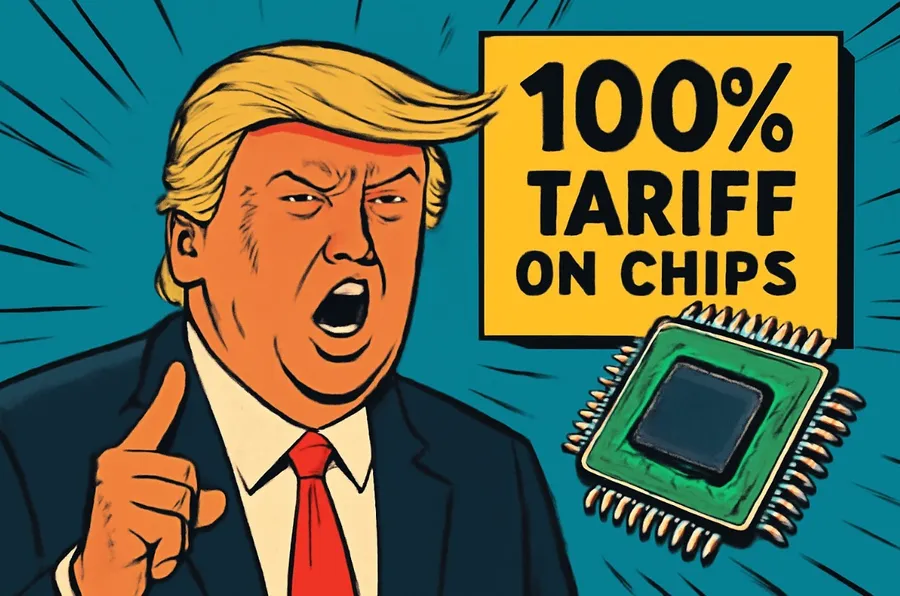
The United States is raising the pressure on global chipmakers. On August 6, President Donald Trump announced that imported semiconductors will face a 100 percent tariff unless the company is currently building or has committed to building manufacturing facilities in the United States.
This new policy was unveiled during a press conference at the White House, where Trump appeared alongside Apple CEO Tim Cook. It signals a major push to bring advanced manufacturing back to US soil. For tech startups in Taiwan, South Korea, and elsewhere, the message is clear: adapt quickly, or risk losing access to one of the world’s largest markets.
Trump stated that the new tariff would apply to all chips and semiconductors entering the United States but added that exemptions would be available to companies investing domestically. According to Reuters, he said, “If you’re building in the United States, or have committed to build, without question, there will be no charge.” He also warned that companies making false claims would face penalties later, adding, “If, for some reason, you say you’re building and you don’t build, then we go back and we add it up, it accumulates, and we charge you at a later date. You have to pay, and that’s a guarantee.”
Apple and TSMC Move Fast to Stay Ahead
Apple responded immediately with a major investment announcement. Tim Cook confirmed that the company will invest an additional 100 billion US dollars in the United States over the next four years, raising Apple’s total US commitment to 600 billion.
This expanded plan includes partnerships with companies like Corning, Texas Instruments, Broadcom, and GlobalFoundries. Apple also continues to work closely with TSMC in Arizona. According to official disclosures, TSMC has committed 165 billion US dollars to its US operations, which include six chip fabs, two advanced packaging plants, and a new R&D center.
Trump praised TSMC’s role in reshaping the US tech landscape, even stating that the company could eventually invest up to 300 billion, though TSMC has not confirmed that figure. For key customers like Nvidia and AMD, who rely on TSMC’s US fabs, this alignment is likely to help them avoid the new tariff.
Smaller Players Face Bigger Challenges
While large players like Apple and TSMC are well positioned, the new policy could create serious problems for smaller companies and startups. Many Taiwanese and Asian semiconductor firms do not have the capital to build facilities in the United States. Without local production, their chips could become significantly more expensive for US buyers.
Reuters quoted Brian Jacobsen, Chief Economist at Annex Wealth Management, as saying that the new tariff will widen the gap between large and small players. “Large, cash-rich companies that can afford to build in America will be the ones to benefit the most. It’s survival of the biggest,” he said.
Some US allies may benefit from more favorable treatment. Both South Korea and Japan have reached agreements with the US that reportedly cap chip tariffs at 15 percent. The European Union has also secured a similar deal covering most exports. By contrast, Taiwan faces both the 100 percent chip tariff and a recently confirmed 20 percent tariff on general goods, including electronics and machine tools.
The impact of the new rules may vary depending on how companies structure their supply chains. Many fabless chipmakers rely on manufacturers like TSMC or Samsung. If their production is located in the US, they may avoid the tariff. But for others with fully offshore operations, the costs could rise sharply. The policy is also expected to target Chinese firms like SMIC and Huawei, whose chips are largely produced and assembled outside the US.
What Founders Should Do Next
Even though the full details of the tariff exemptions are not yet published, the shift in tone and policy is clear. Companies are already reacting. TSMC’s stock rose more than 4 percent on news of the likely exemption, and other tech firms have begun reassessing their investment plans.
Founders working in hardware, components, or electronics that involve US markets should immediately review their supplier locations, pricing models, and logistics plans. While the White House has not specified what qualifies as “committed to build,” waiting could mean missing the window to adapt.
Sources: Taiwan News, Business Next, Bloomberg, Reuters, The Verge
©2026 Business Next Media Corp. All Rights Reserved. No.102, Guangfu S. Rd., Da'an Dist., Taipei City 106, Taiwan