©2026 Business Next Media Corp. All Rights Reserved. No.102, Guangfu S. Rd., Da'an Dist., Taipei City 106, Taiwan
InstaPodz Lets You Turn Any Question Into a Personalized Podcast Instantly
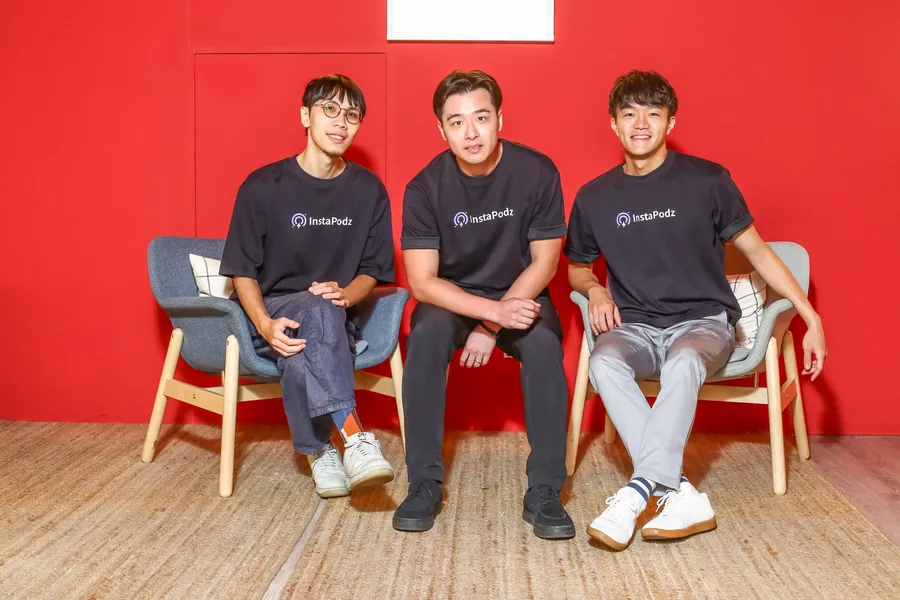
Finding the perfect podcast episode for your commute or your curiosity sounds simple, but for Ansen Huang, CEO and co-founder of InstaPodz, it was a daily pain point.
“I found myself stuck in traffic every day, searching for something that fit what I wanted to learn or listen to, but I often just could not find it,” Ansen Huang remembers. Instead of settling for what was available, he decided to build something better.
With co-founders JJ Liou and Po Yu Huang, both former PicCollage colleagues, Ansen Huang launched InstaPodz, a startup aiming to transform the way people learn through audio. Their solution: an AI-powered app that turns any question into a short, tailored podcast, delivered in just a few minutes and available in multiple languages.
Turning Frustration into Product Innovation
The inspiration for InstaPodz came directly from real-life struggles. For Ansen Huang, the process of finding relevant content was simply too much work. “We wanted to make it as simple as possible. The vision was that I could just say what I wanted, and the app would automatically collect information online and turn it into a podcast. That would save me time and make learning convenient,” he explains.
As Chief Design Officer, JJ Liou focused on lowering the barriers for users. “Our goal was to lower the barrier for users. We designed the interface to be casual and intuitive, so people would not feel overwhelmed when they wanted to learn something new,” JJ Liou says. The InstaPodz team kept settings to a minimum and used Google’s Gemini model to make it easy for anyone to ask a question, pick a host voice, and get a clear, structured answer.
Quality and engagement are never taken for granted. “It was not hard to gather accurate information, but making sure the podcasts are engaging and concise required constant iteration. People have short attention spans, so we are always working to make each episode focused and interesting,” Ansen Huang reflects.
Audio experience is another focus. The team uses third-party speech tools to smooth out volume and improve clarity. According to Ansen Huang, “For some users, even 2x speed was not fast enough, so we decided to increase the default playback speed by 25 percent. We adjust based on what our listeners need.” Users can also pick different hosts, each with their own voice and accent, and the team is working on adding backstories and tone variations to make episodes feel even more personal.
Every Question Gets a Personal Answer
What makes InstaPodz unique is its ability to create personalized, niche content for a truly global audience. “Our users can generate very specialized podcasts. Some topics are difficult to discuss with others, and some people want to use our app to practice languages. They can ask detailed questions and get answers that fit their needs,” says Po Yu Huang, who leads product.
InstaPodz has attracted about 1,600 weekly active users, and close to 8,000 downloads since launch. Approximately 23 percent of users are in the United States, with another 15 percent in Taiwan, and many others in places like the Philippines and Iraq. Retention rates are strong for a new product. “About 30 percent of new users in Taiwan and 22 percent in the United States come back after seven days, which is promising for such a new product,” Ansen Huang reports.
The diversity of topics is striking. “We see people using the app for things like the history of Taiwanese gangs, investing in the Philippines, or cybersecurity certification. One user generated podcasts in Korean, English, Japanese, and French. This kind of flexibility lets people learn in the way that suits them best,” Po Yu Huang observes.
InstaPodz supports both quick and detailed input. Some users enter just a couple of keywords, while others describe their personal situation at length. The AI generates content with as much detail as needed, and always includes background, key concepts, and a recap.
Privacy and accuracy are priorities for the InstaPodz team. Ansen Huang points out that, “We want to avoid having the AI create fake answers. If a reliable answer cannot be found, the podcast will begin with a disclaimer and we provide source links.” The team believes users deserve transparency and a variety of perspectives, not just a single point of view.
Driven by Experience, Inspired by Users
The three InstaPodz founders have years of experience building products together at PicCollage, which gave them confidence to move quickly but also exposed new challenges. “We have built at least four or five products together, so we understand the process from idea to launch. Fundraising, though, is something new for us,” Ansen Huang admits.
Getting support from the ikigai Launchpad, an accelerator run by 886 Studios, helped shift their mindset about investment and growth. “The accelerator helped us realize that early meetings with investors are about getting advice and building trust, not just about getting funding,” Ansen Huang explains. This support ranged from introductions to help with building a financial model.
The way the team works is collaborative and open. “We each have our own perspectives, and we sometimes disagree about what to build or how to design something. But after years of working together, we all respect each other and are open to different ideas. That helps us make better decisions,” says JJ Liou.
User feedback and creative use cases drive InstaPodz’s evolution. Some users have started generating podcasts as guides for art exhibitions or as travel companions for listening offline. “We heard from users who wanted to generate podcasts about specific artists or history before visiting exhibitions, or to download content for offline listening on flights,” Ansen Huang says. The team is considering these requests and plans to keep downloaded content within the app to avoid copyright issues.
While InstaPodz is focused on B2C, there is already interest from educators and organizations. “We have had teachers reach out to use InstaPodz for creating podcasts that help students learn English or other subjects,” Po Yu Huang shares. The app operates on a subscription model, with a monthly plan at $9.99 and an annual option. Features like gamification, improved recommendations, and podcast discovery are all in development. Offline listening is also on the roadmap.
Currently, InstaPodz is raising a $500,000 seed round, aiming to close by November. “We are still in the early stages, but building a product we truly believe in and actually use ourselves is our biggest achievement so far. That commitment keeps us improving for everyone else,” Ansen Huang concludes.
©2026 Business Next Media Corp. All Rights Reserved. No.102, Guangfu S. Rd., Da'an Dist., Taipei City 106, Taiwan