©2026 Business Next Media Corp. All Rights Reserved. No.102, Guangfu S. Rd., Da'an Dist., Taipei City 106, Taiwan
NVIDIA CEO Jensen Huang Bets Big on the Future of AI at CES 2026
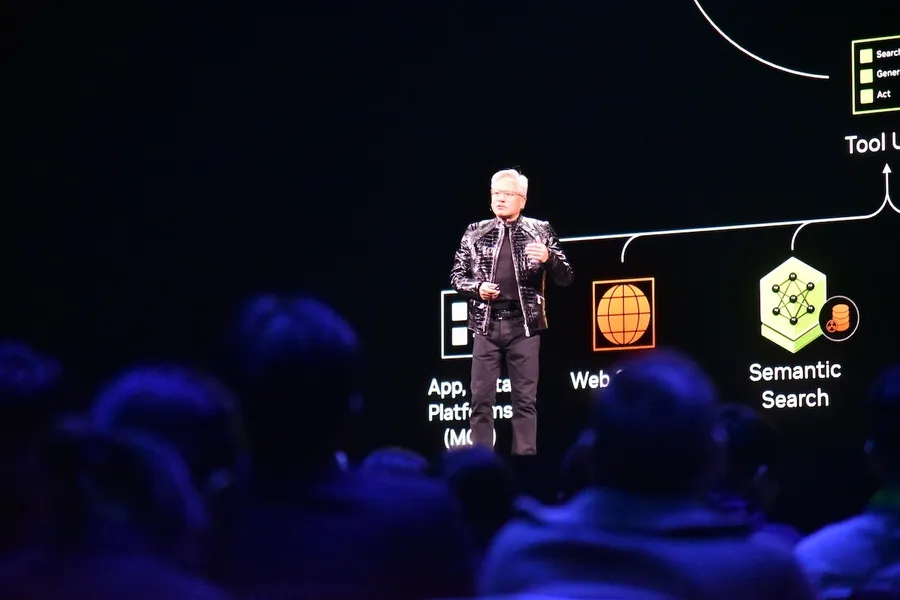
Jensen Huang, CEO of NVIDIA, took the stage at CES 2026 in Las Vegas wearing his trademark leather jacket and radiating energy. “This is my first big bet of the year,” he declared, opening a keynote that would set the pace for the entire show.
With so much talk about an “AI bubble,” Huang faced the doubters head-on. Instead of vague promises, he brought numbers.
He pointed to one hundred trillion dollars in global infrastructure shifting from traditional IT to accelerated computing and AI. “This is where the money comes from,” he explained, showing how AI is now transforming everything from healthcare and pharmaceuticals to legal and creative industries.
Venture capital is pouring in, with hundreds of billions of dollars each year invested in AI’s potential. But Huang also acknowledged real limits. Moore’s Law is slowing, and AI’s demand for compute is skyrocketing as models become more complex and reasoning-intensive. He pointed to startups like Perplexity and Cursor, which are pushing the boundaries of what AI can do.
For Huang, the gap between our current computing power and what AI needs represents NVIDIA’s greatest opportunity.
Startups like Perplexity, which focuses on multi-model search, and Cursor, which builds AI-powered coding agents, are driving this exponential need for compute. For Huang, this proves that AI is fundamentally reshaping human productivity.
When computing supply grows only slightly each year while demand soars, the stage is set for NVIDIA to lead.
NVIDIA Goes Full Stack: The New Blueprint for AI
This year, NVIDIA is not just making chips. Huang revealed an ambitious, end-to-end strategy, covering everything from green energy and hardware to high-speed networking, digital twins, and the AI models themselves. He described it as rebuilding the digital world’s foundation, layer by layer.
- Power and Cooling: New liquid-cooled systems reduce data center energy use and allow servers to run hotter, which is good for both the environment and operating costs.
- The Brains: The Vera Rubin platform, six new chips, and the NVLink 6 Switch are all designed to handle the world’s toughest AI workloads.
- Virtual Worlds: NVIDIA’s Omniverse and Cosmos projects simulate the real world, training AIs in digital environments before deployment.
- Real-World Impact: Models like Alpha Mayo already power autonomous driving features for partners like Mercedes-Benz, demonstrating AI’s real-world potential.
Physical AI, Open Source, and the 20 Billion Dollar Groq Deal
Huang dedicated a large part of his talk to “Physical AI”—robots, smart factories, and systems that blend the digital and physical worlds. In his vision, future factories will operate like giant robots, built and tested first in simulation, then made real.
He also emphasized the power of open-source models, sharing news of new collaborations with Hugging Face to speed up industry-wide AI development.
Later in 2025, NVIDIA struck a 20 billion dollar deal with Groq, a rising AI chip startup. Instead of a traditional acquisition, this partnership gives NVIDIA access to Groq’s technology and top talent. The move aims to keep NVIDIA ahead of rivals, especially in high-speed AI inference for real-time voice assistants.
If there is a takeaway from Huang’s high-energy keynote, it is that the AI revolution is only getting started. NVIDIA is betting not just on faster chips but on building the entire ecosystem—energy, software, simulation, and hardware—to fuel the next era of intelligent machines.
©2026 Business Next Media Corp. All Rights Reserved. No.102, Guangfu S. Rd., Da'an Dist., Taipei City 106, Taiwan