©2026 Business Next Media Corp. All Rights Reserved. No.102, Guangfu S. Rd., Da'an Dist., Taipei City 106, Taiwan
The AWS for Robotics: How Anvil Robotics is Ending the "6-Month Nightmare" and Accelerating the Physical AI Era
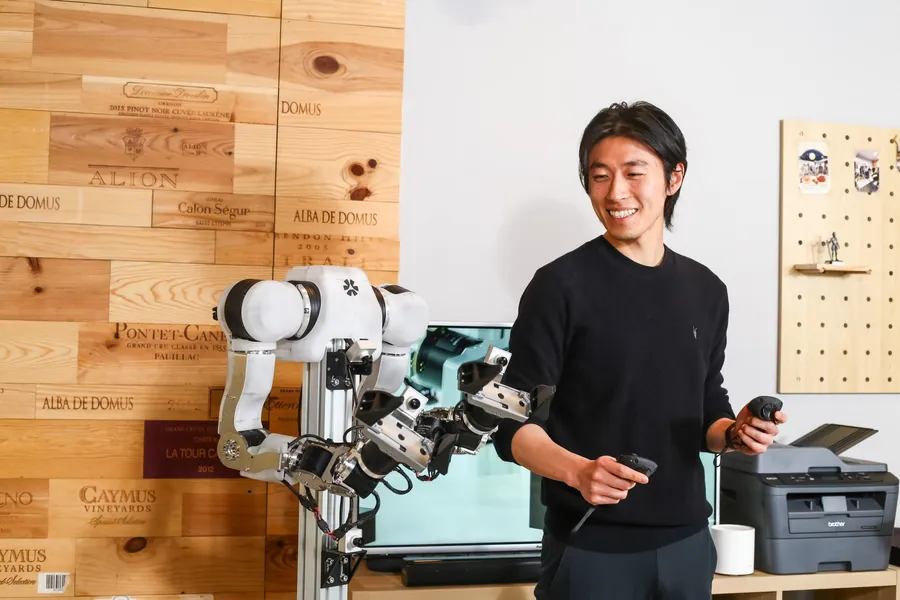
Somewhere in Da’an District, Taipei, an engineer operates a remote controller. Beside him, a humanoid robot mirrors his movements with near-zero latency, smoothly extending its gripper to pick up an object. This isn’t just a demo—it’s a startup, Anvil Robotics, rethinking how Physical AI is built.
Ending the "6-Month Nightmare"
Ask any engineer working on a Physical AI project what the first six months look like, and the answer sounds less like a roadmap and more like a hostage situation: hardware procurement, firmware bugs, control systems built from scratch, and remote operation tools that don’t exist yet—so the team has to build them before writing a single line of AI.
“A lot of teams want to build the brain of the AI,” says Mike Xia, founder and CEO of Anvil Robotics, “but they end up fixing the body.”
Before founding Anvil, Mike spoke with more than 50 companies, and the pattern was clear: teams spent three to six months—and up to $150,000 in hardware costs, using Universal Robots’ UR5 as a baseline—just to reach the starting line for model training. The result was a “Frankensteined” system: expensive to build and difficult to maintain.
As Mike puts it, it’s like building your own servers before writing an app—in a world where AWS already exists.
"Legos for Robots": The Composable Platform
Anvil’s answer is to act as the robotics world’s ODM — a platform provider that handles hardware so developers can focus on intelligence.
Its flagship product, OpenArm, is an open-source dual-arm system with seven degrees of freedom per limb, designed to mimic the range of motion of a human arm. More importantly, it’s fully configurable: arm length, payload, and actuators can all be adjusted based on the use case. Anvil isn’t selling a fixed robot, but a composable platform.
That idea of “composability” marks a shift. Traditionally, robotics has required building or buying systems tailored to specific tasks. Anvil is betting the field is mature enough for modularization—and that developers would rather start with a ready-made physical foundation than assemble one from scratch.
But hardware is only half the challenge. In Physical AI, the real bottleneck is data.
Unlike language or vision models, robots require embodiment data—real-world records of joint movements, currents, temperatures, and motion trajectories during physical interaction. This data can’t be realistically synthesized. Generative AI can simulate many things, but not the thermal behavior of a motor under load or the precise motion of a gripper picking up a raw egg.
“Even with generative AI,” Mike notes, “joint trajectories, current, and temperature changes can’t be simulated. They have to come from the real world.”
To address this, OpenArm comes equipped with a Meta Quest 3 controller, allowing engineers to demonstrate movements directly to the robot for imitation learning and high-quality data collection. Anvil also offers licensed datasets through its modules, giving customers a foundation of up to 80% of general-purpose robotics data, which can then be fine-tuned for the remaining 20% of task-specific needs—dramatically reducing both training barriers and development time.
A Global Pedigree Built on Taiwan’s Resilience
Anvil’s two co-founders, Mike Xia and Vijay Pradeep, met at Matter Venture Partners in Silicon Valley, where both were entrepreneurs-in-residence.
Mike’s background is in scaling commercial platforms. He built Lumina, an AI camera brand that reached $5 million in annual recurring revenue, and later worked on Voltage Park, a cloud compute platform that grew to hundreds of millions in revenue. Vijay, Anvil’s CTO, brings deep robotics expertise, with over 15 years in the field. He founded hiDOF, later acquired by Google, and contributed to early platforms like PR2 and the Robot Operating System (ROS), both widely used in the global open-source robotics community.
The team is split across two hubs: R&D and assembly in Taipei, and software plus remote operation systems developed by Vijay’s team in Trinidad and Tobago.
Taipei is a strategic choice. It places Anvil within one of the world’s strongest hardware supply chains—but also highlights a structural gap. Traditional manufacturers rarely take orders below 1,000 units, excluding most early-stage robotics startups. Anvil takes the opposite approach, offering a minimum order of just four units—tailored for teams still prototyping and iterating.
So far, it’s working. Anvil has shipped over 100 robots to clients including NVIDIA, Path Robotics, and Cobot, along with startups across the US and Southeast Asia.
The Physical AI Moment
This momentum reflects a broader shift. The rise of Physical AI—machines that can reason and respond to unstructured real-world environments—was a central theme at NVIDIA’s GTC 2026, where humanoid robots and autonomous agents were framed as the next frontier.
In this context, Anvil sits at a critical bottleneck: not the AI models, which are rapidly commoditizing, but the physical infrastructure that makes them trainable and deployable.
The garage in Da’an District is, by all accounts, getting crowded.
And that’s usually a good sign—especially when the industry you’re targeting is just beginning to take off.
©2026 Business Next Media Corp. All Rights Reserved. No.102, Guangfu S. Rd., Da'an Dist., Taipei City 106, Taiwan