©2026 Business Next Media Corp. All Rights Reserved. No.102, Guangfu S. Rd., Da'an Dist., Taipei City 106, Taiwan
Taiwan Is the World's Fastest Route From Lab to Factory Floor
Roughly one in three startups that join Taiwan’s Startup Global Program (SGP) end up signing a commercial deal within months. That’s a conversion rate most accelerators can’t match — and one that just crossed 50% in 2025. The latest example: Japanese carbon management startup Asuene, which recently signed with Delta Electronics.
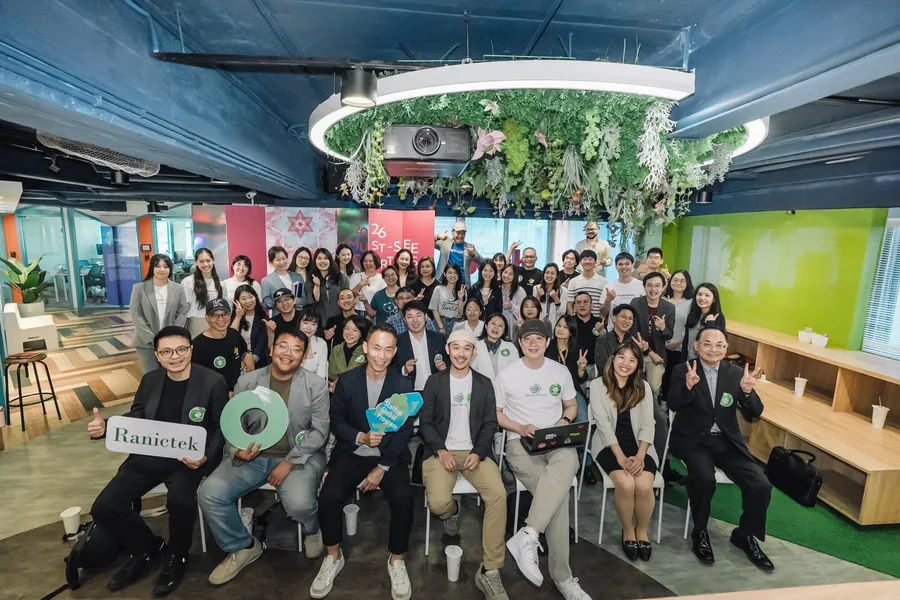
That result has a pipeline behind it: the Startup Global Program(SGP), run by Garage+, the incubation arm of Taipei-based Epoch Foundation. On April 10th, it announced its latest cohort — 31 deep tech teams drawn from 346 applications across 17 countries — marking another lap in what has become a program that reports a 32.7% historical conversion rate.
Quietly, because almost no one outside Asia talks about it. Which, given the numbers, is increasingly hard to justify.
The Scoreboard Most Accelerators Would Rather Not See
Here's the stat that should make every accelerator director in London, Tel Aviv, and Palo Alto uncomfortable: over the program's decade-long history, roughly one in three international teams that join SGP ends up with a formal collaboration in Taiwan — whether that's a proof-of-concept agreement, a distribution deal, or an outright commercial contract. The historical average sits at 32.7%. In 2025, that number crossed 50%.
According to Garage+'s own data, most teams walk away with a proof-of-concept agreement, a distributor relationship, or a formal order within three months of arriving in Taiwan — a conversion pace that most Western accelerators would struggle to match.
Since its founding in 2015 — backed by Taiwan's National Development Council — SGP has processed 3,816 applications from 98 countries, cultivated 330 alumni from 34 nations, and facilitated more than 3,600 business meetings between startups and corporates. The roster of supporting companies reads like a who's who of Taiwan's industrial complex: TSMC, MediaTek, Delta Electronics, Wistron, and more than 60 other major corporations and corporate venture capital arms.
Why Taiwan, and Why Now
The 2026 first-half cohort makes the program's strategic logic explicit. Thirty-one teams. Four focus areas: AI and big data, semiconductors and components, smart manufacturing, and energy management. Every single one of them is a category where Taiwan holds structural hardware advantages that no other ecosystem can easily replicate.
Take the semiconductor picks. South Korea's A Barristor Company is developing graphene-silicon integrated sensor technology — precisely the kind of next-generation component work where Taiwan's concentration of fabs, packaging specialists, and materials suppliers offers an advantage few other ecosystems can replicate. Ranictek, a Taiwanese startup, is building high-performance chip solutions for 5G, 6G, and satellite communications — a domain where Taiwan's supply chain depth transforms what would be a five-year roadmap elsewhere into something achievable in half the time.
The AI and data infrastructure plays are similarly telling. American startup ApertureData is building multimodal database architecture specifically for the AI era — the kind of foundational infrastructure play that finds a natural testing ground in Taiwan's dense concentration of AI hardware manufacturers and enterprise customers. Taiwan-based Bytelingo uses AI to help more than 250 listed companies handle cross-border financial and ESG communications. Both companies are fishing in waters where Taiwan's corporate demand — for AI-native tooling, for compliant data infrastructure — is both deep and immediate.
Then there's the energy angle, which may be the cohort's most forward-looking thread. CreAlien's W2PC pure-water two-phase liquid cooling technology claims to cut data center cooling energy consumption by 97% — a number that sounds like a press release until you remember that AI infrastructure buildout has made data center energy efficiency one of the most commercially urgent problems in tech. South Korea's COSMOS LAB is attacking the same problem from a different angle, with non-flammable aqueous zinc batteries designed specifically for AI data centers. Both companies picked a landing pad that is, by design, adjacent to the world's largest concentration of AI hardware manufacturers.
The Structure Behind the Speed
What makes SGP's conversion rate so anomalous isn't the quality of its startups — plenty of programs recruit excellent founders. It's the architecture of access.
When a startup joins SGP, it isn't attending pitch competitions and hoping a corporate development executive wanders into the room. It's entering a structured pipeline with Garage+'s existing relationships with TSMC, MediaTek, Delta, and dozens of other companies already pre-wired in. The meetings are warm. The counterparts arrive with procurement authority, not just business cards.
HyperAccel, a Korean AI chip startup, signed a PCB motherboard commission design and manufacturing contract with Advantech through the program; American edge AI company CLIKA followed with a deep technical collaboration agreement with the same partner. These aren't pilot projects dressed up as partnerships. They're commercial relationships with one of Taiwan's most important industrial IoT companies.
The result is a compounding effect that is now hard to dismiss. International teams land in Taiwan, move fast, and generate real revenue. Word gets back to their home ecosystems. More applications follow. This year's cohort of 346 applications is itself a data point: teams from Estonia, Hong Kong, Israel, Japan, Poland, Singapore, South Korea, and the United States are all taking Taiwan seriously as a first commercial market, not just a manufacturing outsourcing destination.
The Bigger Bet
The program's 2026 roadmap sharpens the ambition. Garage+ is aligning this cohort's showcase with InnoVEX at COMPUTEX 2026 — the exhibition that has become one of Asia's most important stages for enterprise tech and industrial innovation — explicitly to expand the reach of international corporate matching. The strategic framing is equally direct: doubling down on AI, semiconductors, and green energy as the three domains where Taiwan intends to strengthen what Garage+ describes as its "third leadership position."
It is a deliberately confident posture for a program that still flies largely below the radar of Western tech media. But then, the program has never needed the coverage. It has the contracts.
For a deep tech founder sitting in Seoul or Tel Aviv or Austin, trying to figure out how to get from a promising technology to a real customer in an industry that moves at hardware speed — that is probably the only statistic that matters.
Asuene figured it out. Thirty-one more teams are about to try.
©2026 Business Next Media Corp. All Rights Reserved. No.102, Guangfu S. Rd., Da'an Dist., Taipei City 106, Taiwan