©2026 Business Next Media Corp. All Rights Reserved. No.102, Guangfu S. Rd., Da'an Dist., Taipei City 106, Taiwan
This Is a Declaration": Why a $12.7 Billion Defense Unicorn Just Moved Into Taipei 101
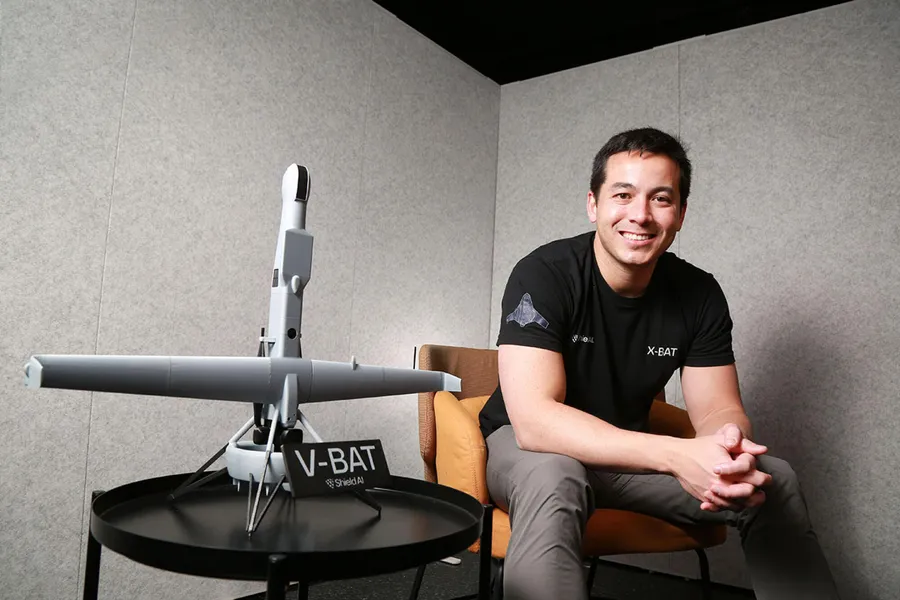
Shield AI has opened an office in Taipei 101, but the move is less about real estate than strategy. The $12.7 billion defense AI startup is positioning Taiwan as a key hub for its autonomous warfare platform. Co-founder and president Brandon Tseng was not coy about the message. "This is a declaration," he said. "We are serious about Taiwan."
In the lexicon of Silicon Valley, "serious" usually means a Series A and a ping-pong table. In Tseng's vocabulary — shaped by seven years as a U.S. Navy SEAL and forged in the specific kind of clarity that comes from being shot at in Afghanistan — it means something more operational. Six people on the ground today. Twenty by December. A signed contract with Taiwan's National Chung-Shan Institute of Science & Technology (NCSIST). And a technology partnership that, if it develops as Tseng envisions, could mean that American and Taiwanese drone swarms share the same AI brain the next time they need to work together.
That last sentence is worth sitting with for a moment.
The Company That Learned to Sell to the Pentagon
Shield AI was founded in 2015 by Tseng and his brother Ryan, born out of a frustration Tseng had carried home from the battlefield. Watching fellow soldiers enter buildings to clear enemy positions — blind to what was inside, dependent on luck as much as training — he kept asking the same question: why wasn't there a drone that could go in first? One that could map the space, locate the threats, and hand soldiers a picture of the room before anyone opened the door?
The answer, it turned out, was that no one had built it yet. Not because the technology was impossible, but because the traditional defense industry — dominated by Boeing, Lockheed Martin, Raytheon — was organized around hardware, not software. Iron and steel, not algorithms. The gap Tseng had spotted from a combat zone was less a technical problem than a cultural one.
Convincing the Pentagon to pay for culture change was another matter entirely.
For nearly two years, Shield AI — then a team of eight — collected rejections. The pushback was predictable: why hand a million dollars to a startup that would probably burn through it? Tseng, drawing on the SEAL ethos of not quitting, kept showing up with better prototypes. The breakthrough came at a Defense Innovation Unit meeting, where one official was willing to pound the table in the company's favor. Shield AI walked out with its first $1 million development contract.
What followed that contract is the product that would eventually make the company's reputation: a compact, hand-launchable quadrotor drone that soldiers could deploy with a single button press. No pilot. No remote control. Powered by Hivemind, no GPS required. The drone flies into the target building, maps the interior, and marks enemy positions as red dots on a smartphone screen. It has since seen action in Iraq, Syria, and Israel — saving lives, Tseng says, in each.
The underlying software powering that drone — and everything Shield AI has built since — is called Hivemind.
What Hivemind Does That Other Drones Can't
To appreciate why Taiwan's military establishment was willing to sign a contract with a Silicon Valley startup, it helps to understand what Hivemind actually solves.
Modern warfare is, among other things, a battle over the electromagnetic spectrum. Jam an enemy's GPS signal, disrupt their communications link, and most conventional drones become expensive debris. In modern warfare, electronic jamming is the rule, not the exception — and any drone that depends on external signals becomes, as Tseng puts it, a kite with a severed string. The proliferation of jamming technology means that any actor with moderate resources can ground a drone fleet that depends on external signals.
Hivemind's core design principle is to make that attack irrelevant. The platform enables aircraft and unmanned systems to operate in what the industry calls GPS-denied, communications-degraded environments — sensing their surroundings in real time, replanning routes dynamically, avoiding obstacles, and completing missions without any human in the loop. Unlike conventional autopilot systems that follow pre-programmed flight paths, Hivemind enables drones to operate autonomously without GPS or communications, adapting to changing environments in real time.
The proof of concept came in Ukraine. Shield AI's V-BAT — a vertical take-off and landing reconnaissance aircraft with a four-meter wingspan — has completed over 130 combat missions there, operating through heavy electronic jamming as one of the few systems able to keep flying. In a conflict that has become the world's most intensive real-world laboratory for autonomous warfare technology, that track record is as close to a product validation stamp as the defense industry offers.
From the V-BAT, Hivemind has expanded its footprint considerably. The software now runs on F-16 fighter jets, as well as on unmanned surface vessels, underwater vehicles, and satellites. The underlying logic remains the same regardless of the platform: put the AI in first, keep the humans safer.
Why Taiwan
When Shield AI looked at where to plant its next flag, the calculus pointed to Taiwan with uncomfortable consistency.
The first reason is supply chain. "Taiwan has the world's best supply chains," Tseng said, pointing to everything from composite materials used in airframe manufacturing to Nvidia chips powering the edge-computing modules that run Hivemind's AI inference engines onboard. In a world where drone production is scaling from hundreds to hundreds of thousands of units, access to that supply chain is not a logistical convenience — it is a competitive moat. The company had also announced a team cooperation agreement with AIDC (漢翔), Taiwan's aerospace industry leader, in 2025.
The second reason is the technology partnership itself. The February 2026 agreement with NCSIST — Taiwan's primary defense research and weapons development institution — is more than a licensing deal. Under the contract, NCSIST will integrate Hivemind's software development kit into its own domestically developed unmanned systems. The goal is to enable swarm operations: a single operator at one ground control station managing and directing multiple autonomous platforms simultaneously. Taiwan, in other words, is not just buying Shield AI's product. It is building its own AI pilot capability on top of Shield AI's foundation.
The third reason is the one Tseng is most direct about: the geopolitical reality that makes the first two reasons urgent. He does not soften it. "The future battlefield will be dominated by millions of AI-driven drones," he has said. The United States cannot manufacture its way to that future alone — not at the speed the competition demands. Taiwan, sitting at the intersection of the world's densest advanced manufacturing ecosystem and the world's most consequential potential flashpoint, is where that gap gets closed.
The Deeper Logic: A Shared AI Language
There is a strategic dimension to the NCSIST partnership that goes beyond the contract's immediate terms, and Tseng has been willing to spell it out plainly.
If Taiwan builds its AI pilot systems using Hivemind's SDK — sharing the same underlying software architecture as U.S. platforms that already run Hivemind — then in the event of a conflict requiring joint operations, American and Taiwanese autonomous systems would already be built to work together. Same decision-making logic. Same communication protocols. Same instincts, in the sense that software can have instincts. The interoperability that military alliances typically spend decades trying to engineer through joint exercises and hardware standardization agreements would, in this scenario, be baked in at the code level from day one.
It is a Silicon Valley solution to a military interoperability problem: don't negotiate a protocol, ship a shared platform.
Tseng frames it in terms of Taiwan's long-term autonomy rather than dependence. The partnership, as he describes it, ensures that even in an extreme conflict scenario, software sovereignty — the ability to control and operate the AI systems — remains in Taiwanese hands. Taiwan will be able to build its own AI pilots. It will not need to call San Diego to ask for permission to fly.
The Argument He Has to Keep Making
As Shield AI's valuation has grown, so has the volume of an argument Tseng clearly expected and has clearly thought hard about.
Autonomous weapons systems — machines capable of making lethal decisions without a human authorizing each action — are among the most contested technologies in both policy and ethics circles. The concern is not abstract: a system optimized to eliminate threats efficiently, operating faster than human oversight can follow, raises questions that do not resolve neatly into press release language about "precision" and "reduced collateral damage."
Tseng's response is grounded in a specific kind of experience. During his time in the SEALs, he says, his unit cancelled missions multiple times to avoid civilian casualties — decisions made under stress, with incomplete information, in the dark. His argument is that an AI system with better situational awareness, no fear response, and no adrenaline flooding its decision-making circuitry is, in practice, more precise than a human soldier operating in those conditions. The problem with human violence in war, as he frames it, is not that humans are inherently cruel — it is that fear makes them imprecise.
"For us, the greatest moral obligation of technology is not to avoid the battlefield," he has said, "but to use absolute technological superiority to prevent war from happening in the first place."
The logic has a clean shape to it. Whether it holds under pressure — whether a Hivemind-equipped drone swarm operating without human oversight would actually make the targeting calls that a SEAL team cancelling a mission would make — is a question that no press interview can answer. It is the question that will define how this technology is ultimately judged.
Tseng is not pretending it is simple. He is betting, with $12.7 billion worth of investor confidence behind him, that the answer is yes.
Six People and a Declaration
There is something almost understated about Shield AI's current Taiwan footprint — six people in one of the most visible office buildings on the island — that is either a sign of careful staging or genuine modesty, and probably both.
What is clear is that the architecture of the commitment extends well beyond headcount. The NCSIST contract is live. The AIDC (漢翔) partnership is in place. The Taipei 101 office is open and recruiting. And Tseng has said explicitly that Shield AI will continue deepening its investment and collaboration in Taiwan over the coming years, supporting the development of local defense capabilities and technical infrastructure.
The company that once spent two years collecting Pentagon rejections has learned something useful about the relationship between patience and timing. Hivemind did not announce itself with a launch event. It showed up as the software inside a hand-launched drone, quietly saved some lives, and then appeared on F-16s.
The Taipei 101 office is the same kind of opening move. Small, precise, and pointed in a very specific direction.
"We want to provide the best office environment to attract the best talent," Tseng said. That is the recruitment pitch. The strategic pitch — the one delivered to NCSIST and to anyone paying attention to where serious defense AI money is moving — lands somewhat differently.
Six people today. The island's best supply chains. A shared AI foundation with Taiwan's defense research establishment. And a founder who learned in Afghanistan that whoever understands the space first has the advantage — before anyone else walks through the door.
©2026 Business Next Media Corp. All Rights Reserved. No.102, Guangfu S. Rd., Da'an Dist., Taipei City 106, Taiwan