©2026 Business Next Media Corp. All Rights Reserved. No.102, Guangfu S. Rd., Da'an Dist., Taipei City 106, Taiwan
A Surgeon Speaks, and the Chart Writes Itself: Inside Taiwan’s Quiet AI Shift
The surgeon doesn’t look up. Both hands still at work, she speaks a short command into the air, her voice calm and precise. In the background, an AI system begins drafting the patient’s medical record. No keyboard. No interruption. The doctor keeps operating. The software handles the paperwork.
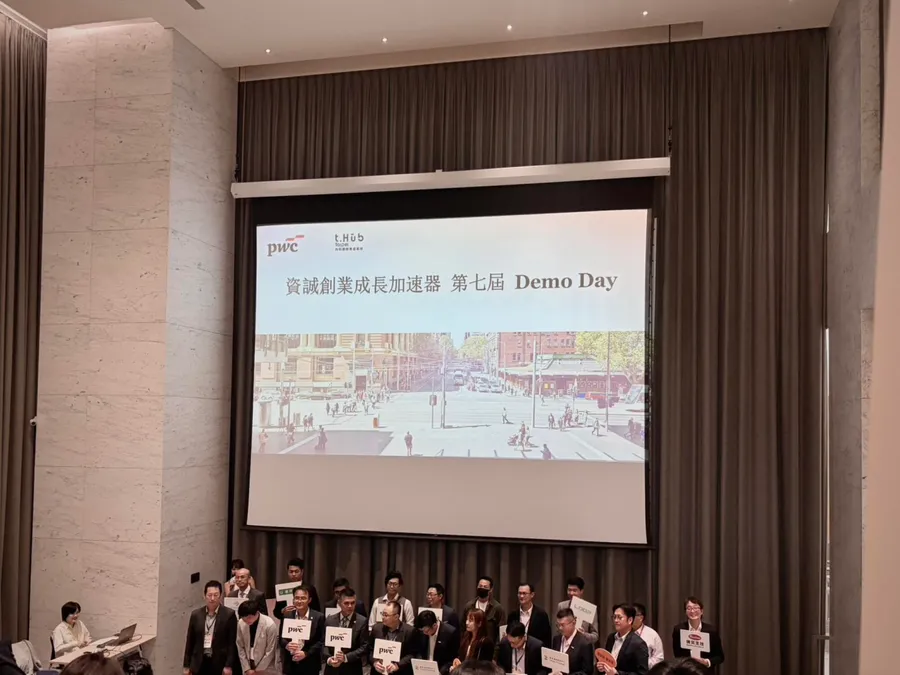
That’s the pitch from Kenkone, one of eleven startups that presented at PwC Taiwan’s seventh annual Demo Day in Taipei on April 16. Its AI voice assistant, EVAS, claims it can reduce medical documentation time by as much as 90%, and has already partnered with Japan’s National Cancer Center and several other healthcare institutions. More broadly, it reflects a shift in Taiwan’s startup ecosystem: away from building general-purpose chatbots, and toward deploying AI in specific environments where routine work still slows people down.
The 85% number that needs an asterisk
PwC Taiwan's 2025 startup ecosystem survey dropped a statistic that, at first glance, sounds like every other AI hype cycle: 85.1% of Taiwan's startups say their businesses are AI-related. Generative AI leads the technology stack at 41.8%, followed by natural language processing at 31.9% and predictive analytics at 31.6%.
The asterisk, however, becomes clear when you look at what the eleven Demo Day companies actually built. Taiwan's AI isn't trying to be a platform. It isn't gunning for consumer mindshare. It's going to places where software has historically been afraid to go — inside hospital equipment, on factory floors where machines can't connect to the internet, and inside the human body itself.
"Artificial intelligence" has topped the ecosystem's keyword rankings for four consecutive years, according to the survey. The more interesting story is where that intelligence is actually being deployed.
A scalpel, not a sledgehammer
Consider the range of problems on display. EndoSemio has squeezed an imaging lens — 0.95mm, smaller than a ballpoint pen tip — into a disposable medical catheter, turning what was once a blind intubation procedure into an eyes-open one. The product has cleared U.S. FDA certification. Meanwhile, DeepRad.AI, a spinout from a radiology team, has built a system that can simultaneously screen for lung cancer and predict cardiovascular calcification risk from a single low-dose CT scan — compressing what used to be a 15-minute reporting process down to 90 seconds. The company has already logged over 25,000 clinical cases across Taiwanese hospitals and received market approval in Japan.
The pattern repeats outside the hospital, too. Blutech has taken the unglamorous problem of factory energy management and rebuilt it from scratch, deploying NeVerLoSs® LoRa wireless technology to eliminate the cost and complexity of running cables through industrial facilities. Its AI energy agent — which moves beyond simple monitoring to actually optimizing consumption automatically — now serves over 100 companies, including Micron and StarLux Airlines. IsCoolLab, meanwhile, has cracked a problem that has stumped many an automation evangelist: how do you automate machines that are sealed, offline, and impossible to modify? Its answer is computer vision-based robotic process automation that captures machine state through video feeds rather than software integration, achieving an 83% improvement in industrial automation efficiency.
This is not the AI of TED talks. It's the AI of founders who have spent years inside specific industries and decided that the best tool is one that disappears into the workflow.
The money is starting to notice
For years, corporate investment in Taiwanese startups was more cheerleading than checkwriting. That appears to be changing. The PwC survey found that the share of corporates with dedicated internal venture arms — CVCs — has jumped from 2% just three years ago to 21.9% today. Large companies, it seems, have concluded that buying access to frontier technology through startup investment is no longer optional.
Taiwan Carbon Shuttle Technology, which has developed a carbon composite material capable of selectively absorbing over 80% of gold from e-waste solutions, is already in talks with an Apple supply chain partner. Unilite's industrial sludge-to-building-material technology helped save NT$200 million in construction costs on a national highway project while cutting carbon emissions by 22% — the kind of ESG-and-economics combination that corporate procurement teams are increasingly mandated to find.
After the demo
The through-line across all eleven companies is specificity. These are not startups building for everyone. They are building for the surgeon who can't type, the factory manager who can't rewire his machines, the oncologist who needs a second pair of eyes at scale. It's a strategic posture that reflects both Taiwan's manufacturing DNA and a savvy read of where enterprise buyers actually spend money.
PwC Taiwan's accelerator has now cultivated 79 startups and helped them raise over NT$2 billion in cumulative funding. The eighth cohort is already open for applications. If the seventh is any indication, the next class won't be building the next ChatGPT. They'll be building the thing that makes a surgeon's hands a little freer.
©2026 Business Next Media Corp. All Rights Reserved. No.102, Guangfu S. Rd., Da'an Dist., Taipei City 106, Taiwan