©2026 Business Next Media Corp. All Rights Reserved. No.102, Guangfu S. Rd., Da'an Dist., Taipei City 106, Taiwan
The $1.1M Bet That Surgery Can Be Learned Like a Video Game
Picture a resident surgeon at 3 a.m., preparing for a high-stakes ECMO cannulation — a procedure where a needle needs to thread precisely into a vessel near a patient's femoral artery. She can't see the vein. She's done the procedure a handful of times. And somewhere in the room, there's a patient whose survival depends on how fast her hands remember what they practiced. The problem? Until recently, the practicing happened on real patients.
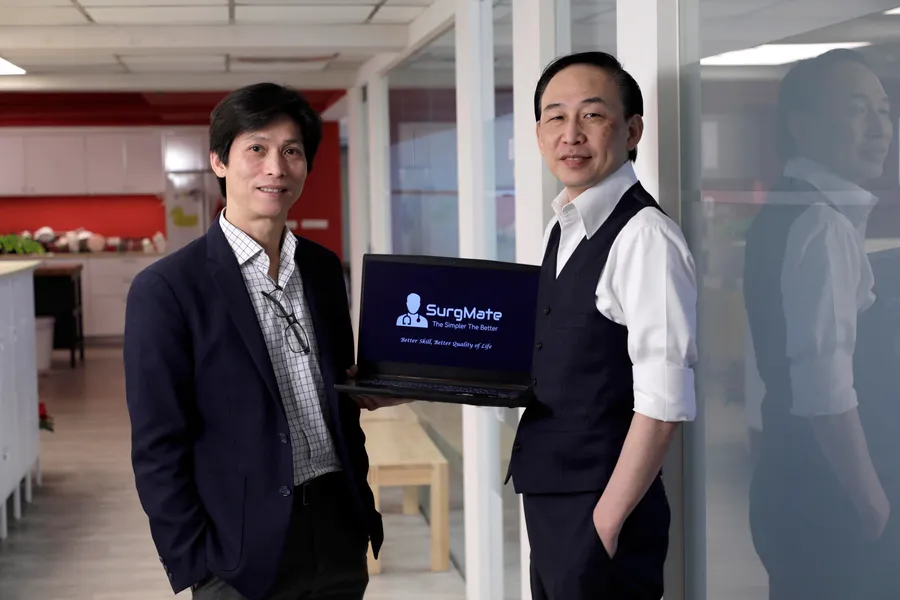
That's the gap that SurgMate, a Taiwanese medtech startup, was built to close. The company just closed a NT$36 million Pre-A round — roughly $1.1 million USD — from a syndicate that includes strategic investors from the medical device supply chain, angel networks, and Taiwan's National Development Fund. The raise is modest by Silicon Valley standards, but the ambition isn't: SurgMate wants to do for surgery what flight simulators did for aviation.
No pilot wants their aircraft to crash. Surgeons are no different.
The analogy isn't just marketing copy. SurgMate's co-founders — CEO Tzu-Cheng HSU and COO Ryan Su — are both aerospace PhDs from National Cheng Kung University. HSU spent over two decades applying fluid dynamics, originally developed to analyze airflow through jet engines, to simulate the behavior of blood in artificial hearts. When he and Su turned that expertise toward surgical training, the question wasn't whether the physics would transfer — it was whether the medical establishment was ready to admit it needed a simulator in the first place.
It's a harder sell than it sounds. Medicine has operated on a "see one, do one, teach one" apprenticeship model for generations — the implicit assumption being that observation leads naturally to competence. A landmark 2016 study published in The BMJ challenged that assumption in uncomfortable terms, estimating that medical errors represent a leading cause of death in the United States. The number rattled hospital administrators and sparked a longer overdue conversation about whether the training pipeline, not just individual physicians, was part of the problem.
SurgMate's answer is a platform it calls a "haptic surgical skills training system" — a category that sounds dry until you see what it actually does. The physical simulators are engineered around two of medicine's highest-stakes domains: cardiovascular intervention and oncological procedures. For cardiovascular training, HSU's team recreated the resistance, pressure, and flow dynamics a guidewire encounters moving through a narrowed artery or past an aneurysm. The simulator uses a transparent casing so trainees can lift the surgical drape after a procedure and see exactly where the catheter went — a feedback mechanism that simply doesn't exist on a living patient.
For oncology simulation, the technical breakthrough is quieter but arguably more important: a self-healing synthetic skin capable of absorbing 100 to 300 or more punctures without meaningful degradation. That's not a minor materials win — it's the difference between a consumable that gets replaced after a single training session and one that can anchor a reusable, upgradeable system. SurgMate has folded in aerospace-style modular thinking, building swappable organ and vessel components that let a single simulator platform cover thyroid ablation one week and vascular access the next.
People don't pay for the product or the technology. They pay for the problem being solved.
Which brings us to the business model — and the part of the SurgMate story that's easiest to underestimate. The company isn't positioning itself as a hardware vendor. It's running a razor-and-blades playbook in an industry that has barely started thinking in those terms. Hospitals and training centers buy the simulator chassis once; they keep buying the skin panels, vessel modules, and pathology-specific tumor inserts as their training curricula evolve. Predictable, recurring revenue from a customer base that is — by definition — professionally obligated to keep training. It's the kind of model that makes investors in medical devices sit up straighter.
The CDMO arm adds another layer. As medical device companies — Medtronic and Terumo are already clients — continuously launch new catheter designs, stents, and ablation tools, they face a stubborn adoption problem: surgeons need to learn new instruments before they can recommend them to patients. SurgMate builds bespoke training simulators for these product launches, inserting itself as a critical node between device release and clinical adoption. In a supply chain that generates billions in new product revenue annually, being the company that trains surgeons to use those products is not a small position to occupy.
The product roadmap extends beyond physical simulators. SurgMate is converting 2D CT scans into manipulable 3D organ models that physicians can walk through in mixed reality — rotating a patient's coronary anatomy in space, identifying the precise entry angle for a catheter before the patient is even on the table. The technology is already deployed at National Taiwan University Hospital. More ambitiously, the company is building what it calls a "digital twin" system: an AI trained on the decision-making patterns of experienced surgeons, available as a 24-hour consultation interface for residents who need guidance outside of clinical hours. It's a knowledge-preservation play as much as a training one — a way to encode what a senior surgeon knows before that knowledge retires with them.
SurgMate landed in the global top eight at the 2025 SelectUSA Tech competition, a signal that its U.S. expansion ambitions are being taken seriously in the right rooms. The Pre-A capital will accelerate that push, alongside continued investment in AI and mixed-reality integration.
The medical training market has seen a wave of simulation companies come and go, most of them running aground on the same problem: hospitals don't have a budget line item for "practicing." SurgMate's bet is that framing the product as infrastructure — and building the consumables and CDMO revenues that make the unit economics defensible — changes that calculus. If they're right, the question for the next generation of surgeons won't be whether they practiced enough. It'll be how many simulations they ran before they ever picked up a scalpel.
©2026 Business Next Media Corp. All Rights Reserved. No.102, Guangfu S. Rd., Da'an Dist., Taipei City 106, Taiwan