©2026 Business Next Media Corp. All Rights Reserved. No.102, Guangfu S. Rd., Da'an Dist., Taipei City 106, Taiwan
Quantum AI’s Startup Opportunity May Begin With Small Problems
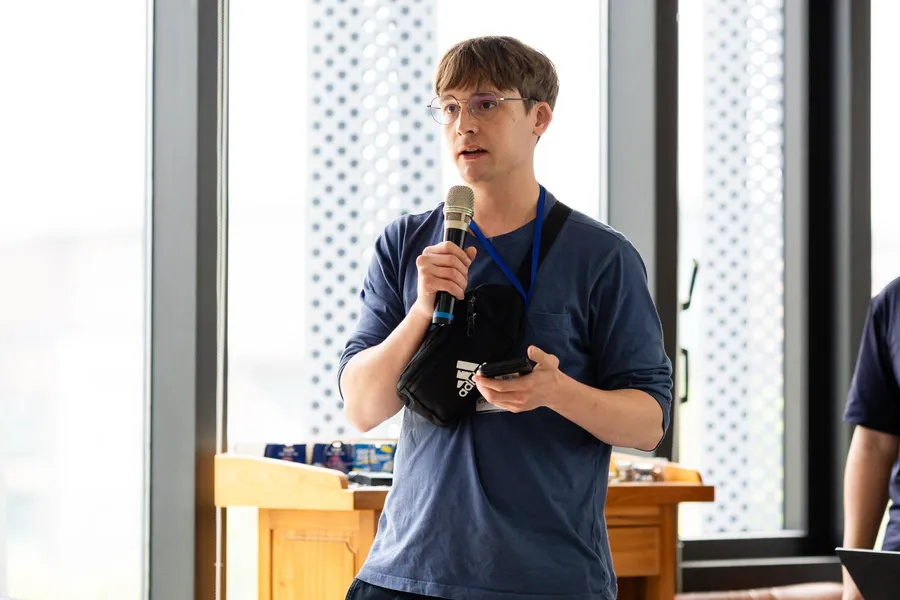
The next opportunity for quantum AI startups may lie in finding smaller problems where the technology can demonstrate value today, rather than waiting for quantum computers to reach their full potential. As quantum hardware, data, and computing capabilities continue to advance, startups and researchers can begin exploring applications and how they might scale over time.
That was a recurring theme at the 3rd International Summit on Quantum AI (SQAI 2026), held August 7 at National Taiwan University and online. Hosted by the NTU Quantum Club, the summit drew 225 registrants, with more than half ultimately participating in person or online. Participants came from Taiwan, Europe, the United States, Korea, and other parts of the world.
Start Small, Demonstrate Value
Austin Hua, Co-Founder and 2nd President of NTU Quantum Club, highlighted the importance of starting with smaller problems rather than waiting for quantum computing to become capable of tackling the largest challenges.
“We can begin with small problem sizes, demonstrate value, and then explore how these approaches scale as we gain more qubits, more data, and better hardware.”
For startups, this offers a practical approach to an evolving technology: experiment with smaller problem sizes, demonstrate value, and build from there as the underlying technology improves.
Beyond a Single Breakthrough
Hua also emphasized that quantum advantage is unlikely to come from one application alone. Instead, he said it will emerge through the “continuous development of new application scenarios by researchers and engineers around the world.”
That creates an opportunity for startups and developers to participate in the ongoing process of discovering where quantum approaches can create value, rather than waiting for a single defining use case.
What Comes After Quantum Computing?
Coined by Hua, the concepts of Ultracomputing and Artificial Ultraintelligence (AUI) represent the ultimate horizon of computation and AI.
“Ultracomputing merges fault-tolerant quantum processors with classical systems to break through silicon's physical limits, unlocking AUI as the most advanced form of superintelligence envisioned, one built to think natively in quantum logic rather than standard 1s and 0s. Powered by quantum phenomena like superposition and entanglement, it enables AI to solve complex global problems and simulate reality at scales never before possible, he explained.
Democratizing Access
SQAI 2026 also highlighted the importance of making quantum technology more accessible. The organizers believe access to quantum hardware and software should not be limited to a small number of institutions or companies, but should extend to students, researchers, engineers, and communities around the world.
Broader access could give more people opportunities to experiment with the technology and contribute to determining where it goes next.
International collaboration was another important part of the summit. SQAI 2026 brought together participants from multiple regions and featured collaboration with QISCA, with the organizers expressing hopes for deeper Taiwan–Korea cooperation.
Potential future initiatives include events, student and researcher exchanges, and collaborative technology R&D projects.
Supported by organizations including the IBM Quantum Hub at NTU, NTU CQSE and NCTS Physics Division, SQAI is positioning itself as a platform for continued exploration and international collaboration around quantum AI.
Quantum AI remains an evolving field, but SQAI 2026 offered a practical message for those exploring its potential: start small, demonstrate value, and scale as the technology develops.
For startups, that may be where the opportunity begins.
-30-
©2026 Business Next Media Corp. All Rights Reserved. No.102, Guangfu S. Rd., Da'an Dist., Taipei City 106, Taiwan