©2026 Business Next Media Corp. All Rights Reserved. No.102, Guangfu S. Rd., Da'an Dist., Taipei City 106, Taiwan
A Hotpot Dinner, 5 Founders, and a House on a Hill: Taiwan's New Wave Arrives in Silicon Valley
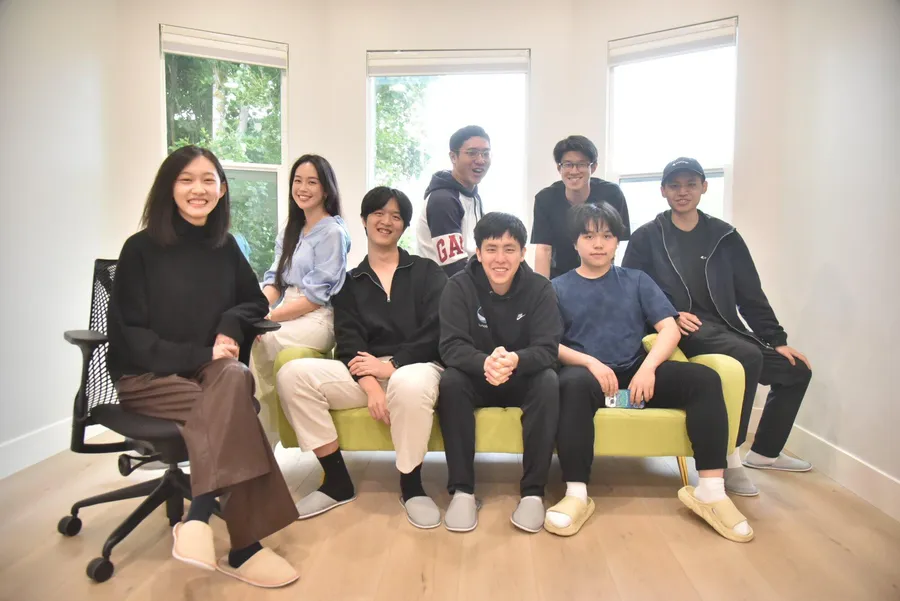
Nobody knows how long the milk cartons in the refrigerator have been there, or whose they are. In the sink, last night's dishes sit exactly where they were abandoned, steak grease congealed into a film of white. It's 8 a.m. in San Francisco, sunlight cutting into the living room, and behind one closed bedroom door a keyboard is already clattering. No one says good morning. Then someone emerges to brew coffee, the smell drifts down the hallway, and one by one the residents surface. Only now does the house's day officially begin.
This is Formosa Founder House, a shared home anchored by Taiwanese founders in their twenties and early thirties. By day, they scatter — pitching investors, working the event circuit, staking out coffee shops where VCs are known to linger. By night, they reconvene to trade gossip from the startup scene and, more usefully, to tear apart each other's half-finished products at the kitchen table.
The house is small; what it represents is not. Over the past year, Taiwanese teams have become noticeably more visible on Silicon Valley's biggest stages. From fall 2025 through summer 2026, the number of Taiwanese startups accepted into Y Combinator grew quarter over quarter. In the same stretch, two teams made it into a16z's Speedrun program, each walking away with investments of up to $1 million.
Three generations, one valley
Taiwanese founders in the Valley are nothing new — but this crop looks different from every wave before it. The first generation came in the 1970s through 1990s: elite engineering graduates who rode the semiconductor and hardware boom, personified by Wu-Fu Chen, the serial entrepreneur Taiwan's press crowned the "god of startups." The second generation emerged around 2000 — Taiwanese Americans like YouTube co-founder Steve Chen and Twitch co-founder Kevin Lin, most of whom moved to the U.S. as kids and operated as thoroughly American founders. In 2017, Taiwan's Business Weekly put them on its cover as the "Silicon Valley Taiwan Gang."
The third generation, arriving after 2020, broke the mold. They didn't grow up in America, and they didn't spend a decade at a U.S. tech giant first. Most finished their higher education in Taiwan and flew straight into the Valley to build — and they're moving fast.
"You have to place this shift inside a longer historical arc," says Lee-Feng Chien, former managing director of Google Taiwan. "The vast majority of this generation went to graduate school, and many had already been abroad by high school. They internationalized far earlier than the generation before them." The runway to a global stage, in other words, got dramatically shorter.
But if early exposure made the leap possible, it was AI that made it urgent.
The night the timeline collapsed
One night in late 2024, Fan-Yun Sun — then a researcher at Nvidia — got his hands on Claude 3.5, the newest model at the time. It was far more capable than he'd expected. "My plan was to start a company in 2026," Sun says, laughing. "In that moment, I realized I couldn't wait." The company he founded, MoonLake AI, builds AI-generated 3D worlds, and its seed round alone topped NT$800 million (roughly US$25 million).
AI didn't just compress timelines. It rewired the economics of starting up. Tzu-Pu Lin, general partner at Cornerstone Ventures, points out that AI has slashed the cost of building prototypes and validating markets — which means early-stage startups need less capital, which in turn lowers the opportunity cost of a young founder gambling on a move across the Pacific. A longtime Valley angel investor who writes under the pen name "Silicon Valley Code Farmer" sees a deeper shift: AI has flipped startups from sales-driven to product-driven, a game of who ships fastest and best. And that game, he argues, pulls founders toward the Valley, where the newest models, sharpest peers, and densest capital all sit within a few square miles.
Penny Chen, founder of Pax, is that shift made flesh. Her platform helps American importers claw back tariffs, and her workflow would have been unrecognizable three years ago. "I don't write code anymore — 99 percent of it is AI-generated," she says. Her days consist of opening several command windows, setting AI agents loose, pouring a coffee, and coming back to review the output. "Starting a company right now is a blessing. One person can do the work of ten." Then the caveat: "A blessing and not a blessing. You're fast, but so is everyone else. The pressure is worse than before."
That's the uncomfortable math. If Taiwanese founders can run faster with AI, so can everyone — including American founders who hold deeper networks and know the Valley's unwritten rules by heart.
Which is, perhaps, exactly why Formosa Founder House exists.
From hotpot to home base
In September 2025, David Day — co-founder and CTO of LunaBill, fresh off a YC acceptance — posted on Threads looking for interns. Yuan-Lin Lin, co-founder of Zeabur, saw the post and invited him to hotpot, rounding up the Taiwanese founders then scattered around the Bay. For Day, it was the first time in nearly two years in Silicon Valley that he'd sat in a circle of Taiwanese people speaking Mandarin.
The road before that dinner had been a lonely one. Day flew over in 2023 with a background in medical AI from Taiwan. "At the beginning I had no idea how to find people. You couldn't even Google it," he recalls. Back then, the Bay Area had almost no community of Taiwanese founders; the Taiwanese he did meet mostly worked at big tech firms. So after the hotpot, he decided to turn a dinner into a home — renting a house and opening its doors to Taiwanese founders headed for the Valley.
The daily rhythm inside is unsentimental. Someone announces, "My product's almost ready — I cut a promo video, can you take a look?" and the room drops everything to pile on: this part is confusing, that section drags, this line needs rewriting. Five young Taiwanese founders under one roof gave the still-forming third generation something it never had before — a visible home base.
Day is adamant, though, about what the house is not. "You come here to trade notes in the gaps, to soften the culture shock. That's it. You still have to find your own way out." Stay inside all day, he warns, and the house becomes just another comfort zone.
No halo, no mercy
The world outside the front door offers no such comfort. Day describes the Valley's competition in blunt terms: lawsuits, corporate espionage, rivals posing as investors to fish for secrets. "By comparison, doing business in Taiwan can be almost naive."
Yuan-Lin Lin has run into a subtler obstacle: valuation gravity. Startups out of Asia typically raise their first two rounds at Asian valuations — lower ones, constrained by market size and capital depth. "To American investors, that's already a red flag," he says. A company arriving with a discounted valuation history triggers a cascade of doubts: Is the growth real? What does the cap table look like? Can the next round support a step up? The negotiation starts underwater. His hard-won conclusion: "If you're serious about the U.S. market, come from Day 1."
The adjustment is psychological, too. Yusan Lin, founder of AI fashion startup Mirror Mirror AI and one of the a16z Speedrun teams, notes that Taiwanese culture tends toward shyness — meetings need a clear purpose. "In Silicon Valley, you can't walk into a meeting carrying expectations," she says. Rejection here is ambient, constant. The only viable response: "It's just one rejection."
What "Taiwan" means now
So what does "Taiwan" actually mean to this generation? For Tony (Yaowen) Chang, co-founder of InsForge, who grew up between China and the U.S. and worked at Amazon and Databricks, the answer took years: "I always felt like I didn't quite belong anywhere. Eventually I realized my label should be what I'm building — not where I'm from."
Day and Lin are equally clear-eyed: being Taiwanese carries no halo in the Valley. And yet, knowing your compatriots are grinding alongside you carries its own weight. Penny Chen puts it with a grin: "Think about it — Taiwan has 23 million people. The world is enormous, and somehow we all ended up here, all building companies. How can you not feel a kind of kinship?"
The old Silicon Valley Taiwan Gang was a circle drawn around people who had already made it. This one is a group of founders still very much on the road, a few of whom decided to walk it together. Whether they'll ever grow into a "gang" worthy of the name, nobody can say. What's certain is smaller, and more concrete: on a hill in San Francisco, there is now a house where the milk piles up in the fridge, the keyboards start before the coffee, and Taiwan's founders have a reason to gather.
The third generation's story is just beginning.
©2026 Business Next Media Corp. All Rights Reserved. No.102, Guangfu S. Rd., Da'an Dist., Taipei City 106, Taiwan