©2026 Business Next Media Corp. All Rights Reserved. No.102, Guangfu S. Rd., Da'an Dist., Taipei City 106, Taiwan
Taiwan Has the AI Edge, but Are Startups Taking Enough Risks?
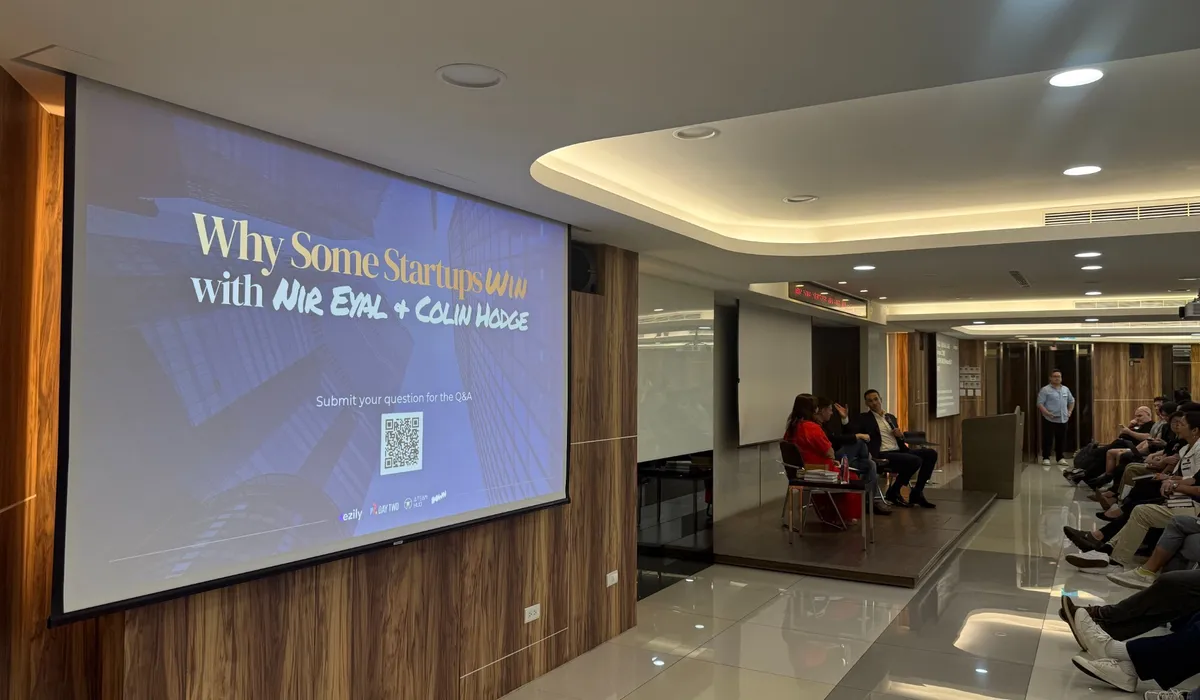
Taiwanese startups have opportunities to capture more value from the global artificial intelligence boom, but a reluctance to take risks could limit their potential, according to entrepreneurs and authors Colin Hodge and Nir Eyal.
Hodge, who has worked in both Silicon Valley and Taiwan, sees risk aversion as a challenge for local founders, while Eyal believes Taiwan's proximity to semiconductor manufacturers gives startups an advantage in developing products beyond chips.
The two shared their perspectives at the Why Some Startups Win fireside chat in Taipei, hosted by Ta-Wei Wang of Pinehurst and Day 1 Coworking. The discussion was moderated by Jenny Hsu, Head Coach of Day 2 Coaching.
Responding to a question from Meet Global about how Silicon Valley's entrepreneurial mindset translates to Taiwan, Hodge identified an avoidance of risk as one of the biggest differences he has observed among Taiwanese founders.
“There's this avoidance of taking risks here that I really try to help people get over,” said Hodge, author of Outrageous Startup Growth.
He argued that founders should consider not only the possibility of failure but also the opportunities they stand to lose by not pursuing their ideas.
“The opportunity cost of not trying is just too high,” he said.
Hodge encouraged founders to imagine themselves one or five years into the future and consider whether they would regret not taking a chance. Learning from setbacks and accumulating small wins, he added, can help entrepreneurs become more comfortable taking risks.
Capturing value beyond Taiwan’s obvious strengths
In a separate interview with Meet Global, Nir Eyal, the New York Times bestselling author of Hooked and Indistractable, pointed to opportunities for Taiwan to capture more value from AI beyond semiconductor manufacturing.
“There's a reshuffling of the deck right now. There's a lot of opportunity,” said Eyal, who was visiting Taiwan to promote his third book, Beyond Belief.
Eyal said Taiwan's proximity to chip manufacturers offers startups an advantage as companies worldwide explore new opportunities across the AI value chain.
He also emphasized the importance of creating products that people actively choose to use, describing his expertise as understanding “how do you make the kind of products that people use because they want to, not because they have to.”
Eyal expressed confidence in Taiwan's potential to produce successful startups, pointing to its semiconductor ecosystem and the opportunities available to entrepreneurs with the right mindset.
During the fireside chat, Eyal also challenged the notion that successful entrepreneurs are necessarily the smartest or most visionary, arguing instead that persistence plays a defining role.
“Persistence does not guarantee success, but quitting guarantees failure,” he said.
However, Eyal cautioned against persisting blindly. He encouraged founders to establish milestones, assess whether they are still learning, and determine whether continued effort can realistically change the outcome.
Taken together, Hodge's observations and Eyal's outlook highlight both the challenge and opportunity facing Taiwan's startup ecosystem: turning its technological strengths into globally competitive businesses will require founders to take risks, learn from failure, and identify where they can create value beyond hardware.
-30-
©2026 Business Next Media Corp. All Rights Reserved. No.102, Guangfu S. Rd., Da'an Dist., Taipei City 106, Taiwan