©2026 Business Next Media Corp. All Rights Reserved. No.102, Guangfu S. Rd., Da'an Dist., Taipei City 106, Taiwan
Recognized by CES Innovation Awards: How AI Is Revolutionizing Indoor Positioning
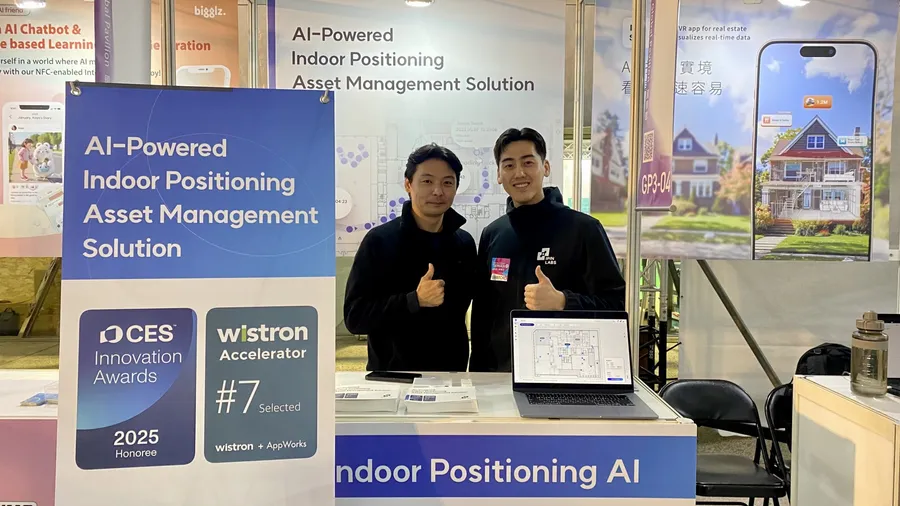
Have you ever tried to find an item or asset in a large building, like a warehouse or a shopping mall, and wondered where it is? Or perhaps you've been in an office or factory and thought, “How can we track all this equipment more efficiently?” Many businesses today are struggling with similar issues: managing assets and personnel in large indoor spaces. But what if there was a way to make this process simpler, faster, and more cost-effective?
Imagine trying to find a specific package in a massive warehouse. You could spend hours walking up and down aisles, or you could rely on an indoor positioning system to pinpoint its exact location. But there's a catch: traditional indoor positioning systems are often slow to deploy, costly, and sometimes not even accurate enough for large-scale use.
As Seongjun Kim, Business Development Lead at IPIN LABS, puts it: "Traditional systems rely on expensive sensors, beacons, or external devices, which are complicated to install and often require days or even weeks to be operational. This makes them unfeasible for small businesses or companies that need to minimize downtime."
What Makes IPIN LABS' Solution Stand Out?
Traditional indoor positioning systems often rely on expensive infrastructure, like sensors or beacons, which can take months to install. They’re complicated, expensive, and disruptive to your daily operations. But the solution the team offers is radically different.
Seongjun Kim explains "Our solution is different because it uses the infrastructure you already have — Wi-Fi and Bluetooth signals — to build the indoor positioning system, making deployment fast and cost-effective."
How does it work? The technology uses existing infrastructure, like Wi-Fi and Bluetooth signals, along with AI algorithms to create a real-time tracking model. This reduces the time and cost typically required for installation. Instead of spending weeks setting up sensors and equipment, businesses can deploy this system in under 24 hours.
Can AI Really Transform Indoor Tracking?
The core of this solution lies in AI — specifically, deep learning algorithms. The system uses data from smartphones and Wi-Fi signals to create an accurate indoor positioning map. You don’t need to manually label or analyze the data. The AI does all the heavy lifting by processing movement data (like acceleration and rotation) and Wi-Fi signal strength to calculate precise positions in real time.
Seongjun Kim clarifies, "We use deep learning to analyze large volumes of data from your smartphones and other connected devices to improve the accuracy of positioning. The system learns from each data point, constantly refining the tracking process in real-time."
Instead of relying on complex hardware and manual setups, AI makes it possible for anyone — even non-experts — to install and manage the system. This dramatically reduces the time and effort involved in setting up indoor tracking systems.
What Are the Benefits for Businesses?
One of the key advantages is faster deployment. Traditional indoor positioning systems can take weeks to install, but this new solution can be set up in less than a day. This means less downtime and faster return on investment (ROI). As Seongjun Kim explains, "The system can be deployed in under 24 hours, which is a game-changer for businesses that need to get up and running quickly."
Cost is another significant factor. Traditional indoor positioning systems can be expensive. However, this solution uses existing infrastructure, such as Wi-Fi and Bluetooth signals, making it 50-80% more affordable than conventional systems. Seongjun Kim points out,"Businesses are often shocked when they see how affordable our solution is compared to traditional systems. We can reduce costs significantly without compromising on accuracy."
This system is also highly scalable. Whether you run a small office or manage a massive factory, the technology can be tailored to fit your needs. It is suitable for businesses of all sizes, from startups to large enterprises.
In terms of asset management, the system offers a substantial improvement. It is then possible to track every piece of equipment in real time, whether it’s a forklift in a warehouse or a laptop in an office. This real-time tracking enhances operational efficiency and helps prevent losses. Seongjun Kim highlights "Real-time asset management gives businesses the ability to instantly locate any asset, improving operational efficiency and preventing equipment from being misplaced."
Finally, the system offers significant benefits for safety and compliance, particularly in industries like manufacturing. Knowing the precise location of personnel and assets is crucial in hazardous environments. This technology enhances safety by tracking both people and equipment, ensuring compliance with safety regulations.
IPIN LABS uses a combination of deployment and usage costs to structure its pricing. The deployment cost is based on the surface area of the facility, as the AI model needs to be tailored to each space. For continuous tracking, businesses pay a subscription fee of about $10 per month per asset.
In addition to this, IPIN LABS also offers an API-based solution for those who wish to integrate the data into existing systems, priced at a couple of hundred US dollars per month for up to 3 million API calls. Businesses seeking more advanced features can opt for the SaaS product, which includes real-time monitoring, geofencing, and detailed reporting.
IPIN LABS' technology has been recognized on a global scale, as the company was selected as a CES Innovation Awards® 2025 Honoree. This recognition underscores the impact and potential of their AI-powered indoor positioning solution, further solidifying its value in improving safety and operational efficiency.
The Impact of AI on Asset Tracking Across Industries
The potential for AI-driven indoor positioning is vast. Logistics companies can track inventory and shipments in real time, cutting down on time spent searching for misplaced goods. Semiconductor manufacturers rely on highly precise asset tracking to ensure smooth operations in cleanroom environments. Airports can improve operational efficiency by tracking ground support equipment and personnel in real time.
Seongjun Kim states "We’ve seen how AI-driven positioning helps businesses in sectors like logistics, where tracking is key to operational success. Imagine being able to track every pallet of goods and every employee in real time – that’s the kind of efficiency we’re enabling."
Looking ahead, indoor positioning could make a big difference in how businesses manage assets in large spaces like warehouses or offices. The ability to easily track items can save time and make operations more efficient.
This technology is useful for businesses of all sizes. It's quick to set up, affordable, and can scale to fit different needs. Thanks to AI, this capability could soon become a reality for businesses everywhere.
©2026 Business Next Media Corp. All Rights Reserved. No.102, Guangfu S. Rd., Da'an Dist., Taipei City 106, Taiwan