©2026 Business Next Media Corp. All Rights Reserved. No.102, Guangfu S. Rd., Da'an Dist., Taipei City 106, Taiwan
Taiwanese Startup Takes on the Quantum Threat: JMEM TEK Forges Next-Gen Security with Hardware Power
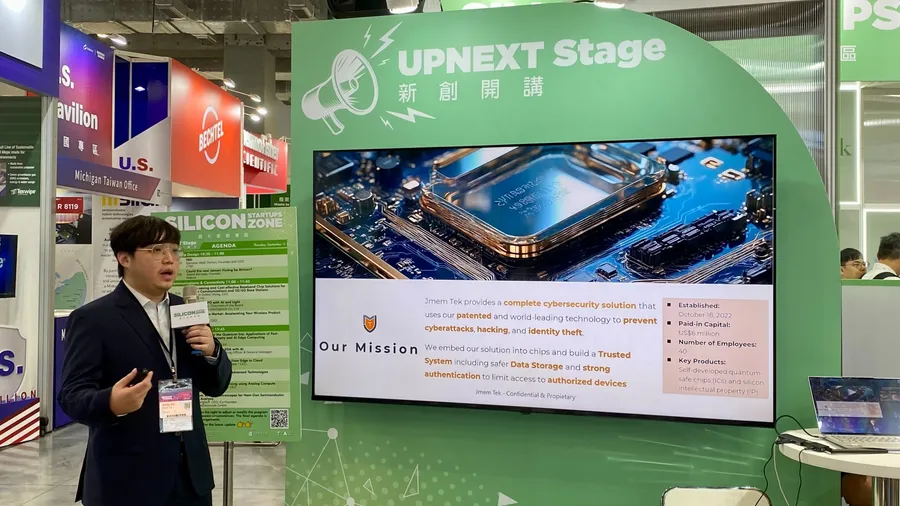
On September 11 at SEMICON Taiwan 2025, in the Silicon Startups Zone, Paul Lo, CTO of JMEM TEK, outlined the challenges that quantum computing brings to cybersecurity and how the company is addressing them through hardware-based solutions.
Founded in 2022, JMEM TEK is a Taiwan-based company with offices in Taipei, Hsinchu, and Silicon Valley. With a team of 40 engineers, the company develops post-quantum cryptography (PQC) and hardware security solutions to prepare for the era when classical encryption will no longer be effective.
The Quantum Threat: Why Encryption Must Adapt
Paul Lo described how quantum computers are capable of solving problems that would take traditional supercomputers millions of years. He referred to Google’s recent experiments, noting that tasks once considered impossible could now be completed in minutes.
“Every time you use your phone, log in to Facebook, or connect to YouTube, encryption is protecting you,” Paul Lo explained. “But to a quantum computer, these traditional systems can be broken efficiently.”
The U.S. National Institute of Standards and Technology (NIST) has already introduced PQC standards. According to Paul Lo, industries such as banking, cloud services, and critical infrastructure will need to migrate to these new methods by 2033.
Hardware Acceleration for Practical Security
Paul Lo noted that while PQC can strengthen security, software-only implementations are often too slow and resource-intensive. To address this, JMEM TEK integrates PQC into silicon. This approach reduces latency by 200 times compared to software solutions and improves energy and area efficiency by up to 3,000 times. It also provides better protection against side-channel attacks such as power leakage and electromagnetic interference.
“Without hardware acceleration, PQC would remain difficult to use in everyday applications,” Paul Lo said.
PUF: Unique Identities in Silicon
Another focus of JMEM TEK is the use of Physical Unclonable Function (PUF) technology. PUF takes advantage of small variations in chip manufacturing to create unique identities for each device.
Paul Lo explained that this method ensures keys remain secure and invisible, even if someone attempts to physically dismantle the hardware. PUF technology supports secure boot processes in devices ranging from laptops to IoT systems, providing a foundation for trust at the hardware level.
In 2023, the company introduced what it describes as the world’s first PUF-based post-quantum cryptography chip. JMEM TEK also offers IC design services and IP integration, supporting clients in embedding PQC and PUF technologies into their own systems.
For entrepreneurs and technology companies considering Taiwan, Paul Lo’s presentation at SEMICON Taiwan 2025 shows how startups are combining semiconductor expertise with emerging security requirements.
©2026 Business Next Media Corp. All Rights Reserved. No.102, Guangfu S. Rd., Da'an Dist., Taipei City 106, Taiwan