©2026 Business Next Media Corp. All Rights Reserved. No.102, Guangfu S. Rd., Da'an Dist., Taipei City 106, Taiwan
Cutting Legal Tasks From 90 Minutes to 9: TwinCounsel Brings AI to Lawyers' Inboxes
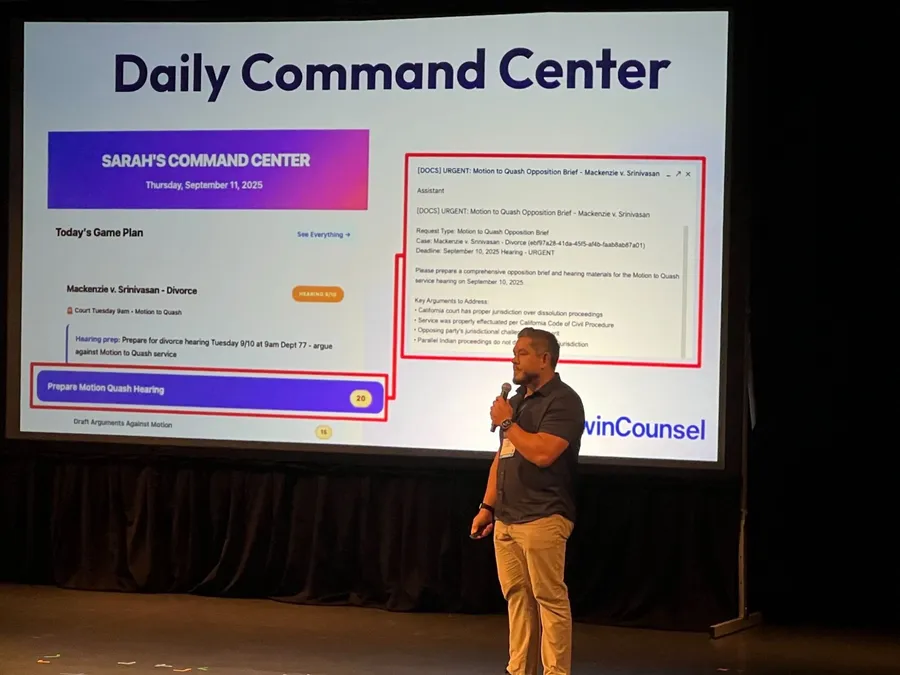
Attorneys in the United States face a familiar problem: too much time lost to paperwork, hunting for files, and wrangling information scattered across digital tools. For solo lawyers and small firms, it means working eight hours but only billing for three. TwinCounsel, a startup founded by Josh Dorward and Kenji Hashimoto, believes the answer is not another dashboard. Instead, they are building an AI-powered teammate that works right inside the place lawyers spend most of their day, the email inbox.
Josh Dorward and Kenji Hashimoto’s story began as freshmen at Cornell, connected by a shared interest in computers. Their academic paths diverged. Kenji remained at Cornell for engineering, while Josh went on to earn law and business degrees at Santa Clara. Even though Josh passed the California bar, he decided to join the startup world, inspired by his entrepreneurial family.
"I grew up in Silicon Valley in the late 90s and always wanted to do a startup. My parents are entrepreneurial, so after law and business school, I knew I didn’t want to practice law, I wanted to build something," Josh Dorward explained.
Startup Lessons Learned Early
The two met again at Zazzle, working together on personalized products. Josh worked in product, Kenji in engineering. This experience led to their first company together, Indivio, which focused on personalized video technology. Although early to the market, they stuck with it and eventually caught Facebook’s interest. Indivio joined the Facebook accelerator, then Y Combinator, and was ultimately acquired by Cloudinary.
While at Cloudinary, Josh saw the rapid development of AI technologies. Yet, when he reached out to law school classmates, he found a surprising lack of adoption. "None of my classmates from law school were using AI at all. Even when ChatGPT became public in 2022, they didn’t know what it was. In 2023, they still didn’t use it, and in 2024, even though awareness was up, they didn’t know how to start using it safely," Josh shared. This gap between technology’s potential and real-world adoption set the stage for TwinCounsel.
Bringing AI Directly to the Inbox
Josh and Kenji took an unusual approach to understand lawyers’ needs. They embedded themselves in a small San Jose law firm for two months, observing daily workflows and running a hands-on proof of concept. Their findings were clear. Lawyers spend about eight hours at work, but can only bill clients for about three, with the rest of their time lost to tasks like searching for files, organizing case materials, and tracking deadlines.
"We saw that lawyers work eight hours a day but only really bill for three, because the rest of the time they’re looking for files, organizing things, and doing work that isn’t billable. Especially in small and solo firms, lawyers feel very inefficient," Josh Dorward observed.
One key insight was that much of a lawyer’s workflow happens in their email inbox, not in dedicated legal software. "I was just at Clio Conference in Boston, the largest legal tech conference for small and solo law firms. More than half of the open laptops in the ballroom were open to email. These lawyers live in email," Josh noted.
TwinCounsel’s answer is the Inbox Command Center, an AI assistant that lives in a lawyer’s inbox. By connecting to their email account, the system scans and understands case-related emails and attachments, then summarizes ongoing matters, tracks timelines, extracts deadlines, and proactively suggests next actions. Lawyers receive a daily summary in their inbox, including the timeline for each case, key contacts, action items, and even drafts of routine documents when needed.
Assigning tasks is straightforward. Lawyers can use pre-written links in the summary email, or simply reply in plain language. For example, they can ask for a subpoena draft for a specific case, and the AI will generate the document, already filled in with the correct context. Most importantly, the system ensures that every suggestion or draft can be fully traced back to the original source. Every fact and field points back to the email, attachment, or document it came from.
"Lawyers won’t trust AI if they can’t see where every answer comes from," Josh pointed out. "Having everything be traceable to its source is super important for anything that the system outputs. You still have to review everything. Nobody’s just sending things from AI without review," he stated.
Their pilot showed a significant improvement. Workflows like preparing financial disclosure documents, which previously took up to 90 minutes, were reduced to nine. Most of the remaining time was spent on reviewing and checking the results.
Connecting Silicon Valley and Taiwan
Legal support in the United States is a $60 billion industry, and more than half of the nearly two million attorneys are solo practitioners. Many are overwhelmed by administrative work and are underserved by most legal tech. "We’re really focused initially on the solo attorney, the person who’s out there being an entrepreneur, trying to run their own business. But frequently their business is running them versus them running the business," Josh shared.
TwinCounsel’s strategy is to work closely with a small number of law firms as design partners and focus on making their first five to ten users truly satisfied before scaling up. "Our goal is to have five to ten people be very, very thrilled with this before we try to expand," he emphasized. Their pricing model is per matter, which matches the industry’s norms and allows law firms to pass costs on to clients. Many clients welcome this as a sign that their lawyers are using tools to improve efficiency.
The startup is in the process of raising a $500,000 pre-seed round, with support from both US and Taiwan-based angel investors. Josh, now a dual US-Taiwan citizen, spent the past year living in Taiwan, caring for his family and connecting with the local startup community. He believes that Taiwan has the engineering talent and ambition needed for world-class product development, and plans to build the core engineering team there.
"In Taiwan, I found a vibrant startup community. What Taiwan kind of needs is that Silicon Valley startup perspective, that more global perspective," he reflected. TwinCounsel is currently recruiting founding engineers interested in AI and full-stack development, people who want to play a bigger role than they might in a larger company.
The journey is not always easy. "Being an entrepreneur is very much balancing optimism with reality. There were times things were very tough, but having a co-founder like Kenji Hashimoto, who I’ve known since college, makes a big difference," Josh admitted. "If you keep seeing progress, you just stick with it," he said.
For now, TwinCounsel is starting with a handful of law firms in the Bay Area, focused on refining the product and making daily life easier for lawyers. With roots in both Silicon Valley and Taipei, the company hopes to eventually bring its AI teammate to lawyers everywhere.
©2026 Business Next Media Corp. All Rights Reserved. No.102, Guangfu S. Rd., Da'an Dist., Taipei City 106, Taiwan