©2026 Business Next Media Corp. All Rights Reserved. No.102, Guangfu S. Rd., Da'an Dist., Taipei City 106, Taiwan
Taiwanese Startups Take Top Prizes at CES Global Deep Tech Battle
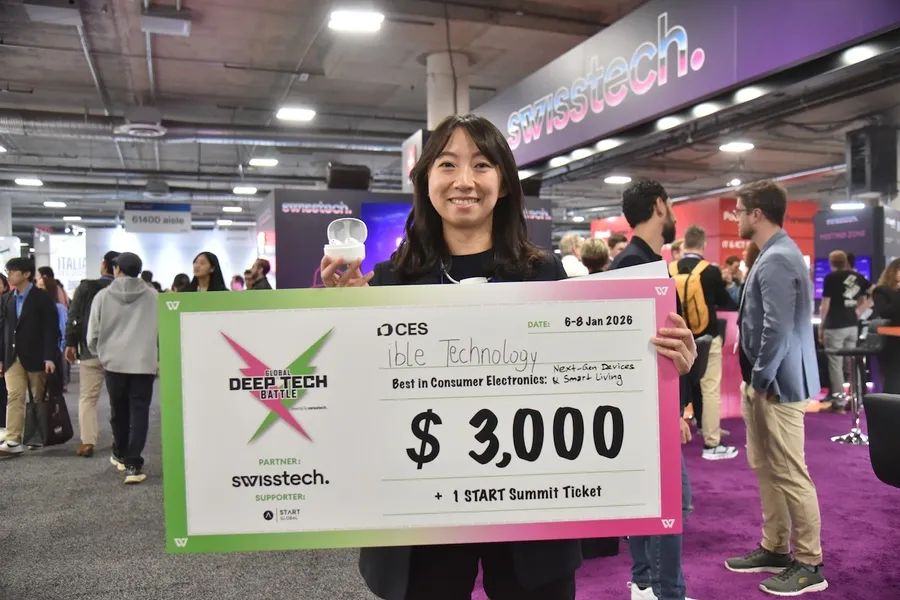
At this year’s CES, Taiwanese innovation was in the spotlight. During the Global Deep Tech Battle at the Swiss Pavilion, two startups from Taiwan, ible and Anivance AI swept the awards for Consumer Lifestyle and Biotech & Medtech.
Both competitions brought together startups from around the world. Each winner received US$3,000 in prize money and a ticket to the Start Summit, Switzerland’s top innovation event.
ible: Wearable Air Purifiers With Global Impact
ible is already well known for its negative ion air purification technology and has won CES Innovation Awards in both 2020 and 2023. The company builds wearable air purifiers that filter harmful particles from the air using negative ions.
In simple terms, most airborne particles carry a positive charge. When they meet negative ions, they become heavier and fall out of the air. This keeps dangerous substances out of your lungs. The challenge for ible was to pack this science into a wearable device that works wirelessly and reliably, while also making sure enough negative ions gather around the user’s mouth and nose.
At CES, ible presented the Airvida T1S, which combines air purification with Bluetooth earphones. The product targets people with allergies, which is a big issue in Switzerland, where nearly one in three people suffers from pollen allergies. “We decided to join the competition because we already have customers in Switzerland,” said Elaine Lin, Senior Manager of Strategy at ible. So far, ible has sold more than 450,000 units in 12 countries. You can even find ible products in airline luxury catalogs.
Swiss angel investor Laurent Oberholzer, one of the judges, said, “Selling 450,000 units proves this is more than just an idea. It really solves a real problem.”
Anivance AI: A Humane Future for Drug Discovery
Anivance AI took top honors in the Biotech & Medtech category with a vision to transform drug development. Instead of relying on animal testing, the team is creating organ-on-a-chip solutions combined with artificial intelligence.
“Ninety percent of drugs that succeed in animal tests still fail in human trials,” said Joyce Huang, PMO Director at Anivance AI. “Animals cannot tell the whole human story.” Drug research costs billions and takes the lives of countless lab animals, yet most treatments do not make it to patients.
Anivance AI’s answer is to use a patient’s own cells to grow miniature organs, like tiny airways, on a microchip. These digital twins can then be used to test new drugs safely and effectively. With the FDA and US National Institutes of Health now encouraging alternatives to animal testing, Anivance AI is well positioned for growth. The company has also gained recognition in Europe, ranking among the top innovators for humanitarian and sustainability solutions. In the last ten months, Anivance AI has expanded into five countries and launched a partnership with Illumina, a global leader in gene sequencing.
Judge Stefan Bauer, a medical electronics executive from Helbling, summed it up. “Combining organ models and AI-driven digital twins is the way forward.”
©2026 Business Next Media Corp. All Rights Reserved. No.102, Guangfu S. Rd., Da'an Dist., Taipei City 106, Taiwan