©2026 Business Next Media Corp. All Rights Reserved. No.102, Guangfu S. Rd., Da'an Dist., Taipei City 106, Taiwan
What Makes a Great Fundraising Pitch? Ben Horowitz Shares 5 Lessons for Founders
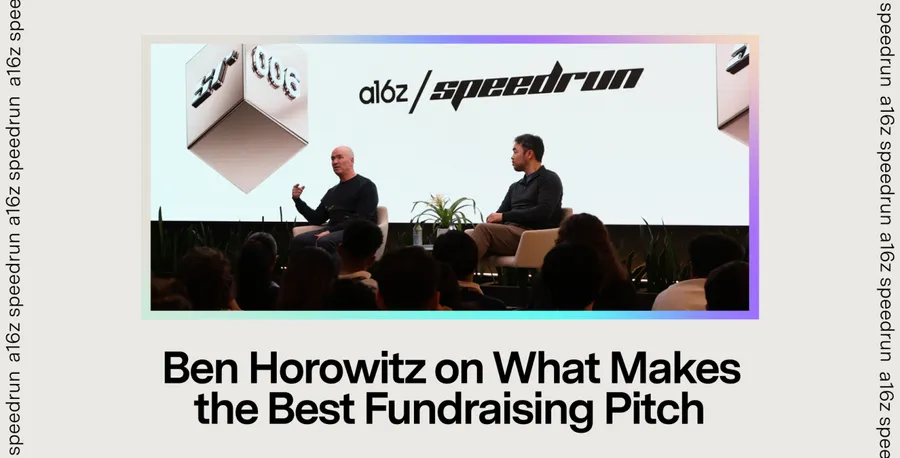
In a conversation with a16z Speedrun general partner Jonathan Lai, Ben Horowitz reflected on how founders should navigate company-building in a rapidly changing AI landscape. While technology is evolving quickly, he emphasized that the core principles of entrepreneurship remain consistent.
One of the most important is how founders define their company story.
1. Your Company Story Is Your Strategy
Many founders treat storytelling as branding or PR. Horowitz sees it as the foundation of strategy. It answers three essential questions: Why does this company exist? Why should people join? Why should investors invest?
For early-stage startups without strong brand recognition, this narrative is often the main driver for attracting talent and capital. When the “why” is clear, the “what” often becomes easier to understand.
He also pointed out that strategy is often confused with KPIs or OKRs. These are execution tools. A clearly defined “why” provides direction and alignment across the team.
To sharpen this thinking, Horowitz recommends writing the company story in long-form. Writing forces clarity and helps founders continuously refine their direction as their understanding evolves.
2. Creativity and Relationship-Building Matter More Than Ever
AI can handle structured and repetitive work. What remains difficult to replace are people who generate original ideas and those who can build meaningful, trust-based relationships.
Horowitz defines creativity as the ability to turn new ideas into reality. He shared that a once highly regarded marketing team at a16z struggled to adapt to the new media landscape because their strengths were rooted in an earlier era. Progress only resumed after bringing in people who understood the new environment.
3. A Product Manager Has Only One Job
Horowitz also revisited his long-standing view on product management: the role ultimately comes down to delivering the right product at the right time.
Product managers often stay busy with meetings, documentation, and user feedback, but these efforts only matter if they lead to that outcome.
Even as AI tools evolve, the core responsibility does not change. Whether writing product requirement documents or prompts, success is defined by execution at the right moment.
4. Opportunities Exist Where There Is Shortage
A practical way to identify opportunities is to look for bottlenecks.
As AI demand accelerates, shortages are emerging across the infrastructure stack, including power supply, chips, compute resources, and data center cooling. These constraints are already limiting growth.
He pointed to a16z’s investment in transformer company Heron Power, where shortages are delaying new power plant construction.
He also noted that long-standing problems, such as cancer, are becoming more solvable as new technologies emerge. The opportunity lies where constraints meet new capabilities.
5. The Best Fundraising Pitch Is the One You Believe In
When it comes to fundraising, Horowitz challenges a common approach. Many founders try to tailor their pitch based on what they think investors want to hear.
Instead, he suggests asking a different question: If you left your company today, would this pitch convince you to come back?
The strongest pitches are built on genuine belief. When founders are convinced by their own story, they are more resilient under pressure and questioning.
If a pitch is based on assumptions about investor expectations, it tends to break down more easily. Horowitz compares this to a relationship built on pretense—where misalignment eventually surfaces.
©2026 Business Next Media Corp. All Rights Reserved. No.102, Guangfu S. Rd., Da'an Dist., Taipei City 106, Taiwan