©2026 Business Next Media Corp. All Rights Reserved. No.102, Guangfu S. Rd., Da'an Dist., Taipei City 106, Taiwan
Ayar Labs Bets on Silicon Photonic Technology and Taiwan’s Chip Ecosystem
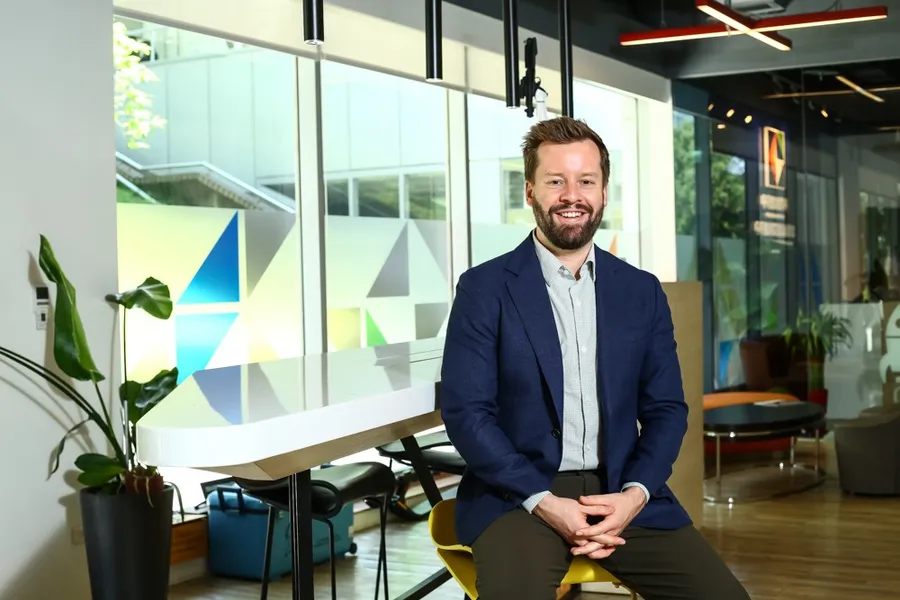
AI systems are growing fast. As models get bigger, chips need to move more data than ever. But the way chips talk to each other is hitting a wall. Wires made of copper are too slow and too hot. Ayar Labs, a startup from Silicon Valley, thinks the answer is light.
The company builds optical chiplets and laser modules that use light signals instead of electricity. After a decade of work, Ayar Labs is now getting closer to high-volume manufacturing. That is why the team opened a branch office in Hsinchu, Taiwan, earlier this year.
From research labs to real products
Ayar Labs was founded in 2015 by a group of researchers from MIT, UC Berkeley, and the University of Colorado. The problem they saw was clear: computing power was still improving, but the way data moved between chips was not. The team believed light could help solve that gap.
“We always believed a bottleneck was coming,” shared Mark Wade, co-founder and CEO of Ayar Labs. “And that light would be the answer.”
At first, their idea was not popular. Mark Wade and his co-founders removed the term “silicon photonics” from their pitch decks. They worked long hours from a small apartment in Berkeley, designing chips and visiting investors. After more than 100 meetings, they raised their first funding round from Founders Fund. Playground Global led the next round in 2018.
Over time, more strategic partners joined. Ayar Labs received backing from several major industry players, including AMD, Intel, and NVIDIA. These investments gave the team direct insight into real-world needs in AI systems and helped shape the company’s direction toward high-performance computing.
That support helped them build real products. One is a laser module. The other is a small silicon chip, called a chiplet, that goes inside GPU and CPU packages. Together, they send light signals between chips. This makes data move faster and keeps systems cooler.
Why Taiwan matters now
Making this kind of chip is not easy. Laser modules need materials like indium phosphide. Chiplets need advanced silicon processes like the ones used at TSMC. Putting both together requires working with many different suppliers.
This is one reason Ayar Labs chose Taiwan. The company now works with partners in Taipei, Hsinchu, Tainan, and Kaohsiung. In Hsinchu, they set up a small office near the high-speed rail. It is a temporary space for now, but a larger office is planned later this year.
“We can’t solve problems from far away,” stated Mark Wade. “We need to be here, on the ground, next to our manufacturing partners.”
The Taiwan office will focus on operations, testing, and helping solve technical problems quickly. Mark Wade said this will help them learn faster and prepare for higher production in the next two to three years.
He also emphasized that even with political risks, Taiwan remains the best place for advanced chip production. “If you want to build advanced semiconductor products today, you have to be in Taiwan,” observed Mark Wade.
Getting ready for scale
Right now, Ayar Labs is working closely with large chip companies and manufacturing partners to get ready for mass production. The company expects demand to grow quickly, especially in AI data centers. Mark Wade added that the goal is to reach a large production ramp around 2027 or 2028.
To help with adoption, Ayar Labs built the first optical chiplet that follows the UCIe standard. That makes it easier to connect with other chips inside one package. The company is also working with partners on testing tools and packaging methods to support this new kind of chip.
The team is small but highly technical. Of the 125 engineers at Ayar Labs, more than 70 have PhDs. Mark Wade said the company is also hiring in Taiwan and looking for local talent to help grow the new office.
“We want to make this technology reliable at scale,” said Mark Wade. “After that, we just keep improving. In deep tech, you have to keep moving or you fall behind.”
©2026 Business Next Media Corp. All Rights Reserved. No.102, Guangfu S. Rd., Da'an Dist., Taipei City 106, Taiwan