©2026 Business Next Media Corp. All Rights Reserved. No.102, Guangfu S. Rd., Da'an Dist., Taipei City 106, Taiwan
Canada Launches Its First Official Pavilion at Meet Taipei to Advance AI and Semiconductor Collaboration in Taiwan
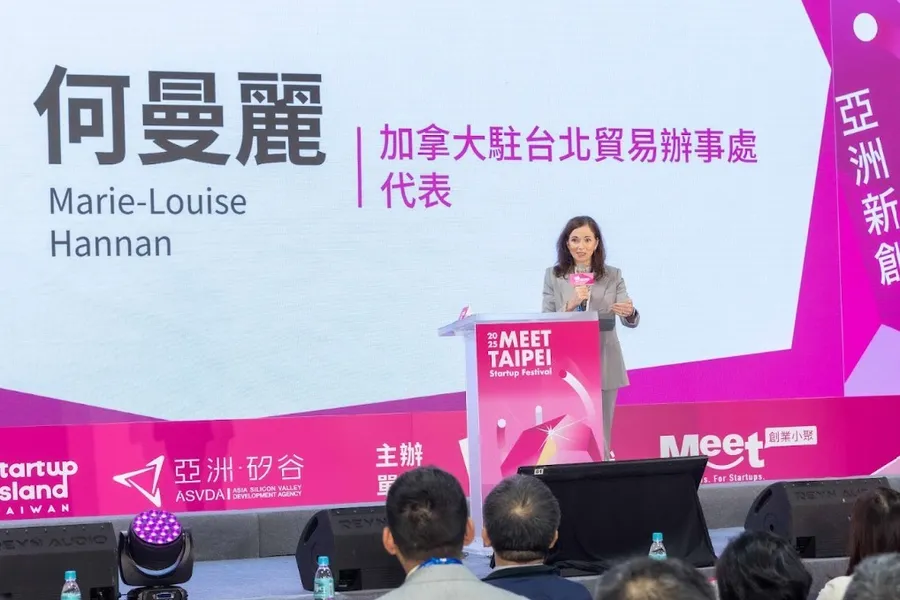
Asia’s leading innovation and startup event, Meet Taipei, is taking place at the Taipei Expo Dome. As the AI era drives higher industrial complexity, Taiwan’s hardware and semiconductor ecosystem is placing even greater emphasis on international collaboration.
This year’s exhibition brings together nearly 400 participating organizations, with international exhibitors accounting for more than one-quarter of the show. Teams from 19 countries—over one hundred startups—present a broad and diverse view of the global innovation landscape.
For the first time, the Government of Canada has established an official “Canada Pavilion,” showcasing eight startups across AI, semiconductors, sustainable technology, food tech, and health tech. The pavilion reflects Canada’s growing commitment to Taiwan’s innovation ecosystem and signals a clear intention to deepen cooperation in forward-looking industries.
Canada Is Deepening Collaboration with Taiwan in AI and Semiconductors
At the Meet Taipei opening ceremony, Marie-Louise Hannan, Executive Director of the Canadian Trade Office in Taipei, stated that Canada’s decision to launch its first official pavilion reflects the country’s growing commitment to working more closely with Taiwan. She noted the strong momentum of Taiwan’s innovation ecosystem, describing it as an ideal environment for deeper engagement between the two economies.
Hannan explained that Canada’s 2022 Indo-Pacific Strategy places new emphasis on strengthening ties with key partners across the region, and Taiwan plays an essential strategic role in that plan. “We hope to deepen cooperation with Taiwan in technology, supply chains, and talent exchange. Taiwan is a trusted long-term partner,” she said, underscoring the importance of building a more integrated innovation corridor between the two sides.
She also highlighted Canada’s strength in foundational AI research—supported by leading institutions in Toronto, Montréal, and Edmonton, and shaped by influential figures such as Nobel laureate Geoffrey Hinton. These capabilities, she said, create natural alignment with Taiwan’s globally recognized leadership in semiconductor manufacturing and smart production, forming a strong basis for collaboration in emerging AI–hardware integration.
Hannan further emphasized that Taiwan’s inclusive and diverse innovation environment mirrors Canada’s own social values, creating an additional layer of compatibility for long-term cooperation. She noted that the Canadian Technology Accelerator (CTA) program—launched in 2019 to help Canadian startups expand globally—has in recent years placed increasing focus on Taiwan as a priority market. This, she added, reflects both Canada’s confidence in Taiwan’s ecosystem and the growing opportunities for companies from both regions to build meaningful cross-border partnerships.
RUNWITHIT Synthetics: Exploring New Collaboration Opportunities in Taiwan
RUNWITHIT Synthetics (RWI) from Edmonton develops AI simulation systems that help governments and organizations understand how cities function, including energy use, transportation patterns, and emergency response. The platform can also model human behavior, making it useful for planning disaster readiness and smart-city management.
CTO Dean Bittner noted that RWI sees strong potential for collaboration with Taiwan. “Our goal is to turn complex decisions into clear visual models that help leaders act faster and with more confidence,” he said.
During Meet Taipei, RWI signed an MOU with the Taiwan Indigenous Sustainability and Development Association (TISDA), becoming one of the key cross-border partnerships formed at this year’s event.
Illumia Labs: AI Models That Capture Expert Knowledge
Illumia Labs develops AI systems that turn expert “tacit knowledge” in engineering, manufacturing, and healthcare into simple, practical training tools. Their technology reads technical documents and guidelines, builds a model of how experienced workers think, and uses VR to let trainees learn through natural interaction with an AI version of a senior mentor.
Co-Founder and CEO Alan Tay noted that both Canada and Taiwan are facing a major wave of retirements among skilled workers. “Our aim is to preserve the knowledge that senior workers have built over decades,” Tay said. “By turning their experience into AI and VR training modules, new staff can learn faster and apply those skills immediately on the job.”
Illumia Labs’ approach provides industries in Taiwan and Canada with a scalable way to keep critical skills alive and support the next generation of professionals.
AuX Labs:The Future of Dairy Doesn’t Moo.
AuX Labs, based in Vancouver, is a food-tech company using precision fermentation to produce recombinant casein, a key protein for next-generation dairy products. AuX Labs engineered yeast strains enable a more sustainable, lower-carbon alternative to traditional animal-derived casein.
“We’ve completed our 1,000-liter pilot facility and are already producing casein at almost USD 20 per kilogram, putting us close to the cost of bovine casein. Compared with others in this space, we’re operating with more than a ten-times cost advantage,” said Ted Jin, Founder and CEO of AuX Labs.
Given Taiwan’s agile food-manufacturing ecosystem, quick product-development cycles, and strong consumer interest in nutrition and clean-label ingredients, the market presents a compelling opportunity for AuX Labs to validate commercial use cases and build partnerships as it expands into Asia.
Canadian Startups Bring Advanced Vertical AI Applications to Taiwan
The Canadian delegation also introduced AI solutions designed for key verticals such as energy, healthcare, and robotics. These companies aim to partner with Taiwan’s world-leading hardware, semiconductor, and smart-manufacturing sectors to accelerate real-world deployment.
MaxEpic, led by semiconductor veteran Dr. Jerry Zhai, develops chiplet-based power-delivery solutions designed for the extreme current demands of modern GPUs and CPUs. By using proprietary voltage-conversion IP that raises input voltages—for example, 1.4V or 2.1V for CPUs and 2.0V to 2.4V for HBM I/O—the system can cut current flow by half or more while achieving up to 97% efficiency. This greatly reduces AI-server power consumption and lowers data-center operating costs. The technology is especially relevant to Taiwan, where AI-server design and manufacturing remain globally critical.
Ma Robot AI develops navigation algorithms capable of interpreting human movement in crowded environments. Compared with commonly used frameworks such as NAV2 and ROS2, its system can anticipate pedestrian trajectories and plan smoother, more efficient paths for service robots. The technology is particularly suited for hospitals, shopping malls, and office buildings. CEO Winnie Liang noted that Taiwan’s smart-manufacturing supply chain is among the strongest in the world, and the company hopes to partner with local robotics hardware makers to deliver safer and more intelligent mobile robots.
Autochart.ai focuses on reducing the documentation burden faced by healthcare professionals. Its AI-powered clinical documentation platform supports more than a dozen languages and converts patient encounters into structured medical notes across multiple specialties. Co-founder and Chief Medical Officer Ali Okhowat said the platform is already recognized and used by the WHO and by Harvard Medical School, and he believes it can deliver meaningful efficiency improvements for healthcare teams working in Taiwan’s multilingual clinical environment.
Reflecting Hannan’s comments, the debut of the Canada Pavilion marks a shift from interest to action between the two innovation ecosystems. With Canada contributing strength in AI research and vertical applications, and Taiwan leading in semiconductors and advanced manufacturing, both sides are now well positioned to pursue deeper cooperation in industry innovation. This year’s participation signals the beginning of a more sustained partnership between Taiwan and Canada’s industries in next-generation AI and key vertical applications.
©2026 Business Next Media Corp. All Rights Reserved. No.102, Guangfu S. Rd., Da'an Dist., Taipei City 106, Taiwan