©2026 Business Next Media Corp. All Rights Reserved. No.102, Guangfu S. Rd., Da'an Dist., Taipei City 106, Taiwan
How NTU Students Built a K-pop Sanctuary Using AI and Community Passion
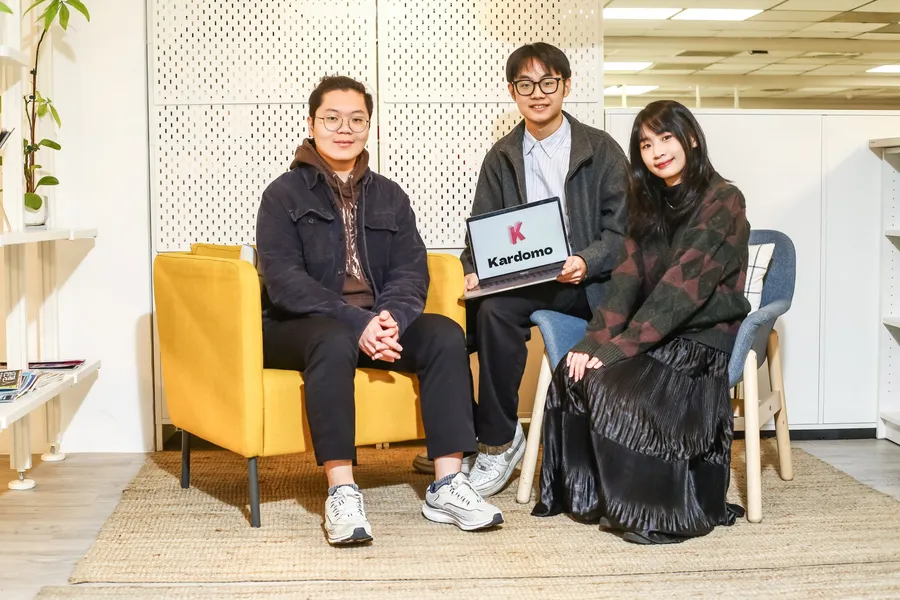
For most K-pop fans, following an idol is a full-time commitment. News, events, ticket drops, fan projects, and collectibles race across dozens of social platforms and group chats. Even the most dedicated followers can feel overwhelmed. That sense of chaos is exactly what sparked a group of NTU students to build Kardomo. Their goal was to create a community-powered app designed to help fans cut through the noise and stay connected to everything that matters in the world of K-pop.
Founded by Cody Peng, Marx Yeh, and Yu-Jhen Yen, Kardomo is not just another social platform. It is a living experiment in how technology, AI, and passionate fans can build something uniquely valuable for the next generation of superfans.
How Kardomo Redefined the Fan Experience
Kardomo’s journey began with the ambition to create a marketplace for trading K-pop photocards, inspired by sneaker exchanges such as StockX. “Some of these cards sell for just a few dozen dollars, but the rare ones go for tens of thousands,” Cody Peng remembered. “It seemed like an opportunity.” The team envisioned taking a two or three percent commission on trades, following a classic platform business model.
However, reality set in quickly. Most fans in the target demographic—middle and high schoolers—lacked purchasing power, and even optimistic projections showed the model was unsustainable. “If we relied only on transaction fees, monthly revenue might reach two to three hundred thousand NT dollars at best, which is not enough to support ongoing technical development and the team,” Peng shared. Without deep initial liquidity, even the best-matched system would fail to take off.
Instead of giving up, the team changed course. They saw an even bigger pain point among fans: the chaos of fragmented information. “We noticed fans struggle to track different group schedules, live streams, and news,” Peng noted. Existing platforms such as Weverse often neglect regional details, including Taiwan-specific events or ticketing information. The team decided to build an all-in-one fan hub, powered by a collaborative calendar and social community. These features were designed specifically for the information overload of modern K-pop fandom.
Launching the first version of the app took just one month. This was possible thanks to the team’s embrace of AI-powered development tools. “We all signed up for AI code assistants,” Marx Yeh explained. “That allowed us to finish about eighty percent of the product in under a month and get it live fast.”
Moderators at the Heart of the Community
The results speak for themselves. Since launching in July 2024 without paid advertising, Kardomo has surpassed thirty thousand downloads, with over two thousand monthly active users. At its peak, it even reached number seven on Taiwan’s App Store rankings. The secret was not just the technology, but the platform’s ability to channel fan passion into collective action.
Kardomo’s calendar feature became a one-stop portal for everything from official comebacks to local fan events. The system works like Wikipedia. Volunteer moderators, known as "萌主" or "版主", are recruited from each fan community and are given the power to curate schedules, review content, and help maintain order. As Yu-Jhen Yen described, “We currently have about eighty moderators—people who are really devoted to their groups and want to help others keep up.” Their motivation is rarely money. “We tried to offer a reward to the top three moderators,” Yen recounted. “They all refused, saying it just made them happy to see everything organized for their group.”
This Wikipedia-like approach also transformed the way fans share and verify photocards. Kardomo built a photocard encyclopedia, a crowdsourced database that helps users identify card versions, compare prices, and flag counterfeits. “The photocard market has its own unwritten rules, but it is chaotic and opaque,” Marx Yeh noted. “Our focus is on making it easier for fans to find reliable information and build their own collections.”
Running this ecosystem with a team of fewer than ten would be impossible without distributed leadership. The moderator system allows the team to maintain quality at scale while fostering a unique, supportive community culture. As one active user told the team, seeing the data all neat and beautiful, and knowing more people can discover my favorite group, just makes me happy.
AI-Powered Iteration and a New Roadmap for K-pop Fandom
Kardomo’s technical edge is its breakneck speed of iteration. The founders admit that inexperience is both a weakness and a strength. “Our biggest advantage is that our time is cheap,” Peng stated. “We test ideas quickly, launch features in days, and rely on data to tell us what works.” Not every experiment succeeds. Features such as music sharing and friend-matching, initially inspired by user surveys, fell flat. The team swiftly redirected focus to what actually resonated.
They credit part of this agility to their experience in the NTU Garage accelerator. “Our mentors taught us that entrepreneurship is not just about solving problems,” Peng reflected. “It is about finding the right product-market fit, and there is no standard answer. You keep raising your chances of success by constantly testing and refining.”
Today, Kardomo remains free to use and avoids intrusive ads. The team is exploring subscription options for advanced features, as well as business partnerships with event organizers. “Promoters do not just care about ticket sales,” explained Yeh. “They want to know where their hardcore fans are, and who is actually going to show up.” By analyzing user interactions and rare card collections, Kardomo aims to offer rich fan insights. This could transform the business model from consumer-driven fees to valuable enterprise data.
Looking ahead, the team is building new apps to deepen the ritualistic experience of fandom. One project maps “birthday cafes”—real-world events where fans decorate spaces to celebrate their idols, a phenomenon especially popular across East Asia. Gamification, collectibles tracking, and even location-based fan quests are all in development.
When asked why they chose this uncertain path over stable jobs at companies such as TSMC, Peng answered with characteristic candor. “If we can make a living from this, then we do not have to go work at a big company. This is just a better path for us.” Yen summed it up best: “As long as we know we are alive and building something that matters, that is enough for now.”
©2026 Business Next Media Corp. All Rights Reserved. No.102, Guangfu S. Rd., Da'an Dist., Taipei City 106, Taiwan